





What's Happening?
Canopy Power Australia, a specialist in renewable energy microgrids, has announced a partnership with Floating Solutions Consulting (FSC) to accelerate the deployment of next-generation floating solar technology across Australia. This collaboration aims
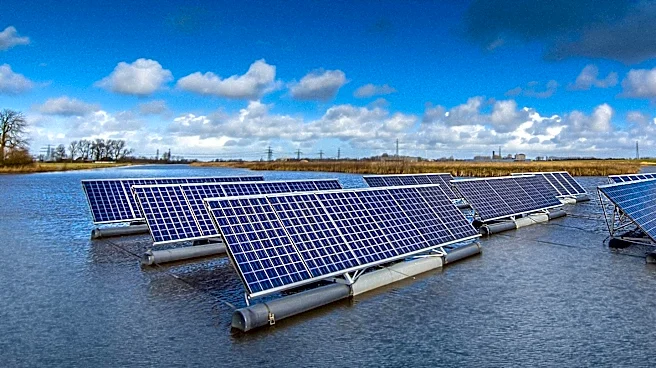
to combine Canopy Power's expertise in solar microgrid and battery energy storage solutions with FSC's maritime engineering knowledge. The partnership is projected to facilitate the deployment of over 50 MW of floating solar infrastructure within the next 36 months. The focus will be on custom floating solar microgrids for commercial and industrial (C&I) clients, with initial projects planned for Victoria and New South Wales. The technology will utilize Norwegian floating PV specialist Ocean Sun's patented system, which features modified silicon solar modules on a 70-meter diameter hydro-elastic floating membrane. This design allows for direct thermal contact with water, potentially increasing energy yield by up to 10% compared to ground-mounted or pontoon-based floating PV systems. The floating rings are also equipped with pumps to harvest rainwater, capturing approximately 2 million liters per year at a typical site.
Why It's Important?
This partnership signifies a significant step in expanding renewable energy generation while addressing critical environmental concerns such as land usage, water scarcity, and water quality. Floating solar technology offers a dual benefit by generating electricity on water bodies, thereby preserving land, and reducing water evaporation by up to 50%, while also limiting algae growth. The ability to harvest rainwater from the solar system's surface provides a valuable resource for clients, particularly water utilities and agricultural operators. The integration of floating solar with microgrid solutions, battery storage, and other energy assets like rooftop solar and wind energy, offers a comprehensive approach to sustainable energy. This development is particularly relevant for target markets including water utilities, data centers, and mining and agriculture operations, which can benefit from both clean energy and water preservation. The introduction of floating charging stations for electric vessels also highlights a forward-thinking approach to sustainable transportation infrastructure.
What's Next?
Canopy Power plans to deploy more than 10 projects across Australia over the next three years, aiming for approximately 50 MWp of installed capacity. The construction of their first Australian project is targeted for the second half of 2027. The partnership will continue to focus on custom floating solar microgrids for commercial and industrial clients, with an expanding pipeline of projects. The company also intends to bring floating charging stations to Australian waters, catering to electric ferries, workboats, and other electric vessels. This initiative suggests a broader move towards integrating renewable energy solutions with various sectors, including maritime transport, and addressing the growing demand for sustainable infrastructure.
Beyond the Headlines
The adoption of floating solar technology, as advanced by this partnership, represents a broader shift towards innovative solutions for energy and water management. The dual benefits of electricity generation and water preservation highlight an integrated approach to resource management, which could become increasingly vital in regions facing water stress and land constraints. The emphasis on microgrids also points to a trend towards decentralized energy systems, offering greater resilience and energy independence for specific communities and industries. Furthermore, the development of floating charging stations for electric vessels indicates a potential for significant environmental impact by promoting cleaner maritime transport and reducing reliance on fossil fuels in this sector. This technology could serve as a model for other countries looking to maximize renewable energy output while simultaneously addressing water resource challenges.