


What's Happening?
AM Batteries (AMB), a Massachusetts-based company, has been named a core subrecipient of a $50 million award from the U.S. Department of Energy's (DOE) Manufacturing Deployment Office (MDO) under the Infrastructure Investment and Jobs Act. This funding
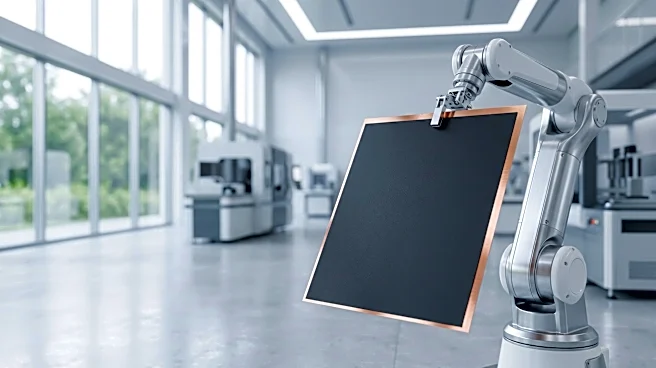
supports a project led by Coreshell Technologies, aiming to establish approximately 2 gigawatt-hours of electrode manufacturing capacity and 1.5 gigawatt-hours of cell assembly capacity within the United States. AMB will contribute its proprietary dry-coating process for cathode manufacturing, known as Powder-to-Electrode™. This innovative technology eliminates the need for toxic solvents and energy-intensive drying steps typically found in traditional lithium-ion battery manufacturing, which relies on wet-slurry casting. The dry-coating process is expected to significantly reduce capital expenditures by up to 40% and operational expenditures by over 50% for battery plants, while also lowering their carbon footprint. The initiative seeks to create a resilient domestic battery supply chain and generate more than 100 domestic jobs in production, technical, and administrative roles.
Why It's Important?
This initiative is crucial for strengthening the U.S. domestic battery supply chain, reducing reliance on foreign manufacturing, particularly from Asia, and fostering economic growth through job creation. By eliminating toxic solvents and energy-intensive processes, AM Batteries' dry electrode technology offers a more sustainable and cost-effective method for battery production. This advancement is vital for the electric vehicle (EV) and defense sectors, as it promises higher-performance, lower-cost cells. The project directly addresses the challenge of making domestically produced high-performance battery cells cost-competitive with mass-market cells from other regions. The U.S. aims to gain a fundamental advantage in manufacturing and materials, rather than simply replicating existing technologies, which is essential for building a globally competitive battery industry. The reduction in CAPEX and OPEX makes domestic battery manufacturing more economically viable, encouraging further investment and innovation in the sector.
What's Next?
The project, led by Coreshell Technologies with AM Batteries as a key partner, will proceed with building out the specified electrode and cell assembly capacities in the U.S. This will involve deploying AM Batteries' dry Powder-to-Electrode™ platform and integrating it with advanced material technologies, such as Coreshell's MGS anode technology. The focus will be on proving the cost-competitiveness and high performance of 100% domestically produced battery cells. The success of this project could lead to broader adoption of dry electrode manufacturing processes across the U.S. battery industry, potentially attracting more investment and partnerships. The creation of over 100 domestic jobs is an immediate next step, with further job growth anticipated as the domestic battery supply chain expands. Continued research and development will likely focus on further optimizing the dry-coating process and material integration to enhance battery performance and sustainability.
Beyond the Headlines
The shift towards dry electrode technology represents a significant paradigm change in battery manufacturing, moving beyond the environmental and economic drawbacks of traditional wet-slurry methods. This innovation has broader implications for industrial sustainability, as it reduces the use of hazardous chemicals and energy consumption, aligning with global efforts to decarbonize manufacturing. Furthermore, the emphasis on domestic production addresses national security concerns by securing critical components for defense applications and reducing geopolitical vulnerabilities associated with reliance on foreign supply chains. The success of such initiatives could also inspire similar technological advancements in other manufacturing sectors, promoting a more localized, efficient, and environmentally responsible industrial landscape. This project underscores a strategic national commitment to technological leadership and economic resilience in critical emerging industries.