



What's Happening?
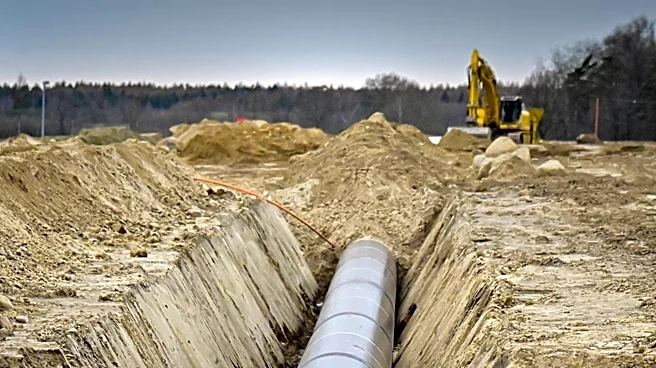
The Solitude Pipeline System joint venture, comprising WhiteWater, Devon Energy Corporation, MPLX LP, Diamondback Energy, Inc., and Western Midstream Partners, LP, has reached a Final Investment Decision (FID) to construct two 48-inch natural gas pipelines.
These pipelines will transport natural gas from the Permian Basin to Katy, Texas. The project has secured significant long-term firm transportation agreements with predominantly investment-grade shippers, which was crucial for the FID. The joint venture is structured with WhiteWater holding 50.0%, Devon Energy 25.0%, MPLX 10.0%, Diamondback Energy 7.5%, and Western Midstream Partners 7.5%. I Squared Capital and FIC Partners Management, LP are partners in WhiteWater's investment in Solitude. The project aims to provide scalable, long-haul natural gas transportation to support the growing production in the Permian Basin and increasing consumption along the Gulf Coast.
Why It's Important?
This pipeline project is critical for the U.S. energy sector, particularly for the Permian Basin, which is a major oil and natural gas producing region. The construction of these pipelines will enhance the infrastructure necessary to transport the increasing volumes of natural gas extracted from the Permian Basin to demand centers on the Gulf Coast. This expansion of transportation capacity will help alleviate potential bottlenecks, ensuring that natural gas can reach markets efficiently. For the companies involved, it represents a significant investment in midstream assets, securing long-term revenue streams through firm transportation agreements. The project's ability to support Permian Basin growth and Gulf Coast consumption underscores its importance in maintaining energy supply chain stability and meeting industrial and residential energy needs in the region. It also highlights continued investment in natural gas infrastructure as a key component of the U.S. energy landscape.
What's Next?
The Solitude Pipeline System is expected to commence service in phases, with an initial capacity of approximately 2.25 Bcf/d in late 2029, followed by an additional 2.25 Bcf/d in 2030. The design allows for further capacity increases to meet future shipper demand, with commissioning schedules that can be adjusted based on market dynamics. The project's entry into service is contingent upon receiving customary regulatory and other necessary approvals. Over the coming years, the joint venture will focus on the construction and development phases, navigating regulatory processes and ensuring the timely completion of the pipelines. The successful operation of these pipelines will likely lead to increased natural gas flow to the Gulf Coast, potentially influencing natural gas prices and availability in the region.
Beyond the Headlines
The approval of the Solitude Pipeline System reflects a broader trend of continued investment in fossil fuel infrastructure, even amidst growing calls for renewable energy transition. While the project addresses immediate energy transportation needs, it also raises questions about the long-term role of natural gas in the U.S. energy mix and its environmental implications. The substantial long-term agreements with investment-grade shippers indicate a strong market confidence in natural gas as a reliable energy source for the foreseeable future. This development could also influence regional economic growth, creating jobs during construction and operation, and supporting industries reliant on natural gas. The project's phased approach and flexibility in capacity expansion suggest an adaptive strategy to market changes, balancing current demand with potential future shifts in energy policy and consumption patterns.