




What's Happening?
An international team of researchers has successfully trained a five-metric-ton John Deere 332G skid-steer loader to perform complex autonomous maneuvers, including balancing on two wheels, navigating uneven terrain, and spinning in place. This achievement,
detailed in 'Science Robotics,' utilized artificial intelligence trained through reinforcement learning in simulation. The research, involving experts from ETH Zurich, Gravis Robotics, Blue River Technology, and Intel, addresses the inherent challenges of automating heavy hydraulic machinery, which typically exhibits non-linear behavior and complex physical dynamics. By collecting operational data from the physical machine and developing a neural network to predict hydraulic actuator behavior, the team was able to train AI controllers in simulation without human operator demonstrations, then transfer these controllers to the physical vehicle, running on a standard laptop.
Why It's Important?
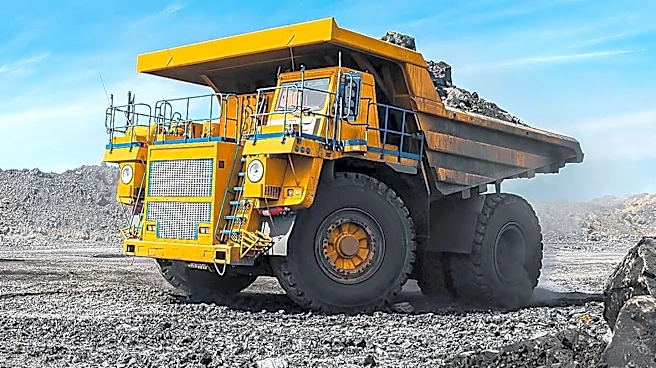
This breakthrough holds significant implications for U.S. industries such as construction, mining, agriculture, and material handling. The ability to automate complex maneuvers in heavy machinery can lead to increased efficiency, enhanced safety by reducing human exposure to hazardous environments, and potentially lower operational costs. For instance, the research suggests that these techniques could enable construction vehicles to self-load onto trucks without ramps, negotiate obstacles autonomously, and perform recovery maneuvers in challenging conditions. The successful application of simulation-trained AI to full-scale hydraulic machinery demonstrates a viable pathway for more sophisticated autonomous control, which could revolutionize how heavy equipment is operated and maintained across various sectors, leading to substantial economic benefits and improved productivity in the U.S.
What's Next?
Future research in this area is expected to integrate advanced sensing technologies like lidar and cameras to enhance environmental awareness, alongside higher-level AI systems capable of dynamically selecting appropriate control skills for different situations. While the current experiments do not signify commercial readiness, they lay a crucial foundation for the development of commercially viable autonomous heavy machinery. The potential applications extend beyond mere acrobatics, aiming to reduce tire scrubbing and ground damage on sensitive terrains through controlled balancing. This ongoing development suggests a future where heavy construction and industrial vehicles are increasingly autonomous, requiring new skill sets for human operators who will transition from direct control to supervision and maintenance of these advanced AI systems. The U.S. market can anticipate a gradual integration of these technologies, starting with specialized tasks and expanding as the AI systems mature and regulatory frameworks adapt.
Beyond the Headlines
The successful training of AI for heavy machinery raises profound questions about the future of labor in industries reliant on such equipment. While automation promises efficiency, it also necessitates a re-evaluation of the workforce, requiring new training programs for operating and maintaining AI-driven machines. Ethically, the deployment of autonomous heavy machinery in complex environments will demand robust safety protocols and clear lines of accountability in case of malfunctions or accidents. Legally, new regulations will be needed to govern the operation of these vehicles, particularly concerning liability and operational standards. Culturally, there may be a shift in public perception regarding the capabilities and safety of autonomous heavy equipment. The long-term impact could be a transformation of industrial landscapes, with smarter, more efficient, and safer operations, but also a significant societal adjustment to the changing nature of work in these sectors.