

What's Happening?
Octopus Power (SynapX), a Chinese startup specializing in robotic dexterous-manipulation systems, has successfully raised $15 million (US$13.8M) in Series A funding. The investment round saw participation from industrial giant Midea Group. This capital
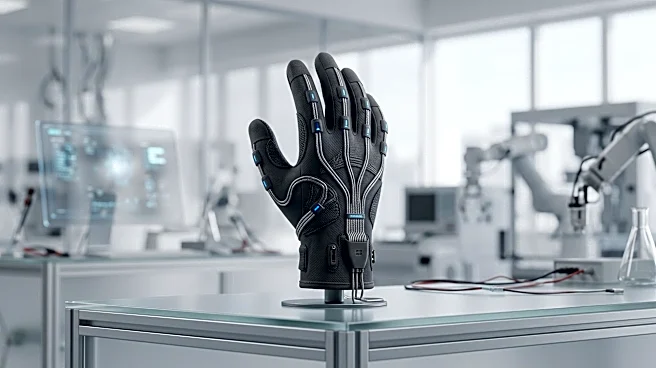
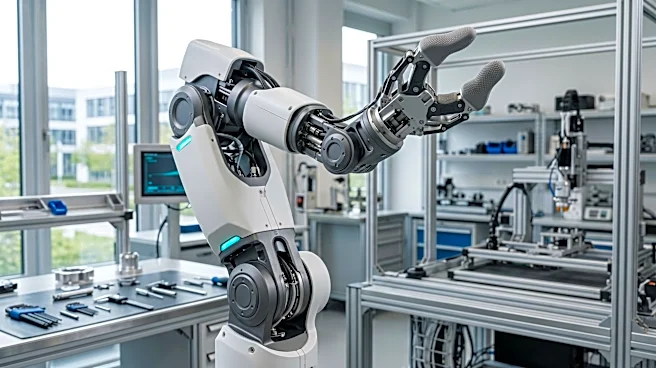
injection is earmarked for two primary objectives: establishing a high-end production line for dexterous robotic hands and advancing the development of its embodied AI models. Founded in early 2026, Octopus Power focuses on enhancing how robots comprehend tasks, manipulate objects, and learn through experience. The company offers a suite of three interconnected products: OctoMind, a model platform designed for developers; OctoH-Hand, a dexterous robotic hand; and OctoSense, a data-collection toolkit that captures human movement, vision, and contact for training AI models. This funding marks the fourth disclosed round for Octopus Power this year, with previous investors including Horizon Robotics, Hillhouse, Xiaomi, and Shunwei Capital, accumulating nearly US$137.5M in three months.
Why It's Important?
This significant investment in Octopus Power highlights the accelerating global race in embodied AI and robotics, with China emerging as a key player. For the U.S. technology and manufacturing sectors, this development signals intensified competition in advanced robotics and AI. The focus on 'physical AGI'—where deployed robots generate data to improve their models—represents a critical frontier in AI development. If successful, this approach could revolutionize automation in manufacturing, logistics, and other industries, potentially leading to more efficient and adaptable robotic systems. U.S. companies in robotics and AI will need to closely monitor these advancements to maintain their competitive edge, particularly as Chinese firms like Octopus Power attract substantial funding and aim for mass production of sophisticated robotic components and AI platforms. The strategic investment from an industrial giant like Midea also suggests a strong push towards integrating advanced AI and robotics into large-scale industrial applications.
What's Next?
Octopus Power's immediate next steps involve utilizing the Series A funding to establish a high-end production line for its dexterous robotic hands and to further develop its embodied AI models. The company aims for mass production and delivery of its core 'brain-hand integrated' platform by the end of 2026. A key challenge for Octopus Power, as noted by its founder and CEO Du Dalong, is the full integration of its models with its dexterous hands, which is a critical task for the year-end. The company will also need to transition from early orders, primarily for data-collection gear from research buyers, to securing sales of its full platform to factories requiring durable, round-the-clock hardware. The broader trend indicates that capital in China's embodied AI sector is shifting from robot demonstrations towards models, data, and real-world deployment, suggesting a focus on practical, scalable solutions.
Beyond the Headlines
The pursuit of 'physical AGI' by companies like Octopus Power carries profound implications beyond industrial automation. Ethically, the development of robots capable of dexterous manipulation and learning from real-world interactions raises questions about the future of human labor, the potential for autonomous systems in sensitive environments, and the accountability of AI in decision-making processes. Legally, the deployment of such advanced robotics will necessitate new frameworks for safety, liability, and intellectual property, especially as robots become more autonomous and capable of complex tasks. Culturally, the widespread adoption of highly capable robots could reshape societal perceptions of technology, work, and human-machine interaction. The long-term shift towards embodied AI could lead to a redefinition of manufacturing processes, supply chains, and even the nature of physical labor, potentially creating new industries while displacing others. This development underscores a global technological race with significant economic, social, and ethical dimensions.