







What's Happening?
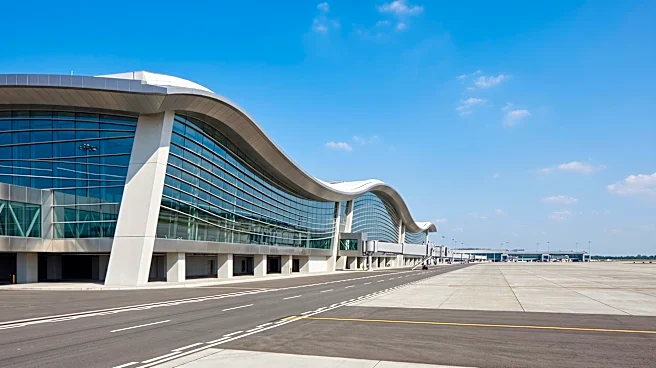
Maharashtra Chief Minister Devendra Fadnavis has stated that there will be no shifting of flights from Mumbai's existing airport to the new Navi Mumbai airport. This declaration comes amidst ongoing discussions and developments concerning airport infrastructure
in the region. According to Fadnavis, his communication to relevant authorities emphasizes a different approach: first developing Terminal 1B, then relocating operations from Terminal 1A to 1B, and subsequently dismantling the original 1A terminal. This strategy suggests a phased modernization and expansion of the current Mumbai airport facilities rather than a direct transfer of flight operations to the Navi Mumbai site. The statement clarifies the state government's immediate plans regarding air travel logistics and infrastructure in the Mumbai metropolitan area.
Why It's Important?
This decision by Chief Minister Fadnavis carries significant implications for air travel, urban planning, and economic development in the Mumbai region. By opting against a full-scale relocation of flights, the existing Chhatrapati Shivaji Maharaj International Airport (CSMIA) in Mumbai will likely continue to be the primary hub, impacting its operational capacity, passenger traffic, and surrounding commercial activities. For businesses and travelers, this means continued reliance on the current airport's infrastructure, potentially leading to sustained congestion if expansion efforts do not keep pace with demand. The Navi Mumbai airport, while still under development, may see a different role, possibly focusing on regional or specific flight categories rather than absorbing a significant portion of Mumbai's current air traffic. This approach could influence real estate values, local employment, and investment patterns around both airport locations, as stakeholders adjust to the confirmed strategy for air connectivity in one of India's largest economic centers.
What's Next?
Following Chief Minister Fadnavis's directive, the focus will likely shift to the detailed planning and execution of the Terminal 1B development and the subsequent relocation of Terminal 1A operations at the existing Mumbai airport. This will involve coordination between airport authorities, airlines, and construction firms to ensure a smooth transition and minimal disruption to services. The role and development trajectory of the Navi Mumbai airport will also need further clarification, as its initial purpose might be re-evaluated in light of this decision. Stakeholders, including airlines, logistics companies, and local businesses, will be closely monitoring the progress of these infrastructure projects and any revised timelines. Future announcements are expected to detail the phases of construction, operational changes, and the ultimate capacity enhancements at Mumbai's primary airport, as well as the refined strategy for the Navi Mumbai facility.
Beyond the Headlines
The decision to retain and expand the existing Mumbai airport rather than shifting flights to Navi Mumbai highlights a broader challenge in urban infrastructure development: balancing the need for new capacity with the optimization of existing assets. This approach could reflect a strategic choice to leverage established connectivity and minimize the economic and social disruption associated with a major operational shift. It also underscores the complex interplay between political leadership, urban planning, and the demands of a rapidly growing metropolitan area. The long-term implications could include a more integrated, multi-airport system where each facility serves distinct roles, or it could lead to continued pressure on the existing airport if expansion cannot fully meet future demand. This scenario also raises questions about the environmental impact of continued operations and expansion in a densely populated urban core versus developing a new greenfield site.