








What's Happening?
The global rotation sensor market is projected to grow at a compound annual growth rate (CAGR) of 6-8% through 2035, according to a recent report. This growth is fueled by investments in industrial automation, the electrification of transport and machinery,
and the increasing integration of sensors in precision equipment. Rotation sensors, which measure angular position, velocity, or acceleration, are essential in closed-loop control systems for electric motors, actuators, robotics, and automotive steering. The market includes various types of sensors such as magnetic, optical, inductive, capacitive, and Hall-effect sensors. Asia-Pacific is a major production hub, while North America and Europe are significant demand centers. The shift from legacy resolvers to contactless magnetic and optical encoder technology is accelerating, particularly in factory automation and robotics.
Why It's Important?
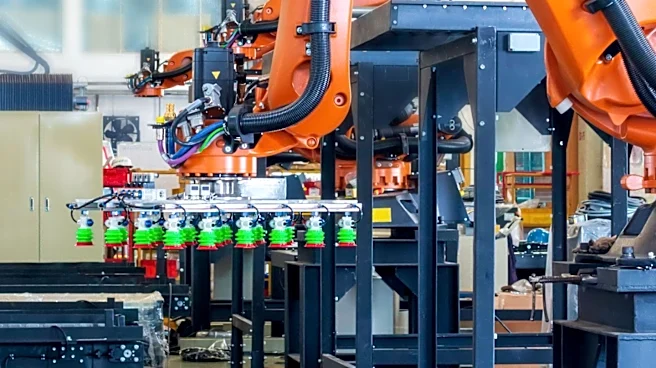
The expansion of the rotation sensor market is significant for several industries, including automotive, aerospace, and manufacturing. As electric vehicles (EVs) become more prevalent, the demand for rotation sensors in motor position feedback and steering angle sensing increases. In aerospace, the trend towards more electric aircraft and fly-by-wire systems is driving the need for high-reliability sensors. The integration of these sensors into smart actuators and IoT-enabled systems enhances operational efficiency and reliability. This growth supports the broader trend of Industry 4.0, where automation and smart technologies are transforming manufacturing processes. Companies involved in sensor production and integration stand to benefit from increased demand and technological advancements.
What's Next?
The rotation sensor market is expected to continue its growth trajectory, driven by ongoing investments in smart manufacturing and the electrification of various sectors. The demand for high-precision sensors in semiconductor manufacturing and medical imaging is likely to increase. As industries adopt more advanced technologies, the need for reliable and accurate sensors will grow. Companies may focus on developing sensors with higher resolution and smaller form factors to meet the demands of miniaturization and precision. Additionally, the market may see increased competition from low-cost manufacturers, putting pressure on unit prices while encouraging innovation in value-added services and premium product specifications.