




What's Happening?
The rapid growth of artificial intelligence (AI) has fundamentally altered the relationship between South Korea and Taiwan, transforming them from fierce technological rivals into indispensable partners. Historically, these economies competed across various
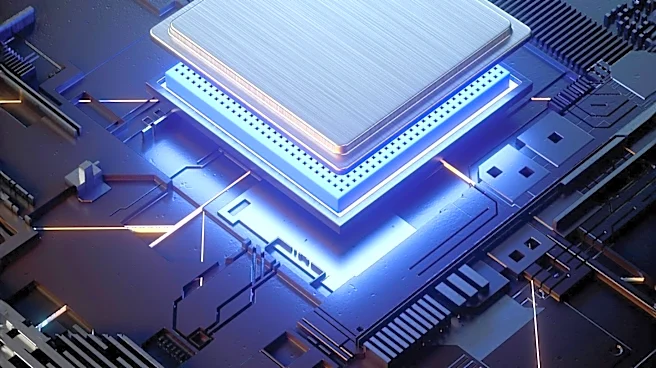
sectors, including televisions, smartphones, and memory chips. However, the escalating global demand for AI accelerators—specialized chips crucial for training generative models—has necessitated an unprecedented level of cooperation. The production of an Nvidia AI server, for instance, now relies on a collaborative effort: Taiwan's TSMC manufactures the computing chips, while South Korea's SK Hynix and Samsung supply the High Bandwidth Memory (HBM), which is essential for quickly storing and transferring large volumes of data for AI. Taiwanese manufacturers then integrate these components into server racks, often equipped with advanced cooling systems. This interdependence is highlighted by the fact that SK Hynix and Samsung collectively produce approximately 80% of the world's HBM, which is then combined with TSMC processors using advanced packaging technologies in Taiwan.
Why It's Important?
This shift from rivalry to partnership between South Korea and Taiwan is critically important for the global technology industry and the U.S. economy. The U.S. relies heavily on these nations for advanced semiconductor components, which are foundational to AI development and numerous other technological sectors. This collaboration ensures a more robust and efficient supply chain for AI hardware, mitigating potential disruptions and accelerating innovation. For U.S. industries, particularly those in tech, finance, and defense, a stable and high-performing AI supply chain is vital for maintaining competitiveness and national security. The increased interdependence also means that any geopolitical instability affecting either South Korea or Taiwan could have significant ripple effects on the global AI market and, consequently, on U.S. technological advancement. The ability to meet the immense demand for AI components through this partnership directly impacts the pace of AI adoption and development worldwide, including in the U.S.
What's Next?
Looking ahead, the deepening economic interdependence between South Korea and Taiwan in the AI sector is expected to continue. This collaboration will likely drive further advancements in chip manufacturing and memory technology, as both nations strive to meet the ever-increasing demands of the AI boom. We can anticipate continued investment in research and development in both countries, potentially leading to new breakthroughs in AI hardware. For the U.S., this means a continued reliance on this critical supply chain, emphasizing the need for stable diplomatic and trade relations with both nations. The 'frenemy' dynamic, combining partnership with rivalry, suggests that while cooperation will persist in AI equipment, competition for investment, advanced technologies, and market share in other areas will also continue. This complex relationship will be a key factor in the global technological landscape for the foreseeable future.
Beyond the Headlines
The transformation of South Korea and Taiwan into essential partners in the AI supply chain has profound implications beyond immediate economic benefits. It highlights a global trend where the complexity and scale of advanced technological production necessitate international collaboration, even among historical competitors. This interdependence can act as a stabilizing force, as the economic well-being of both nations becomes increasingly intertwined with the success of the global AI industry. However, it also exposes vulnerabilities, as disruptions in one region could have cascading effects worldwide. Ethically, it raises questions about equitable access to advanced AI technologies and the concentration of critical manufacturing capabilities in a few key regions. Culturally, it demonstrates how shared economic imperatives can transcend historical rivalries, fostering a new form of technological diplomacy where mutual benefit drives cooperation, ultimately shaping the future of global innovation and economic power dynamics.