





What's Happening?
ARM Holdings' stock has recently experienced a 25% decline over the past month, largely attributed to a broader selloff in chip stocks, which saw the Nasdaq 100 fall 10%, NVIDIA lose 30%, and Intel drop 38% during the same period. Despite this market
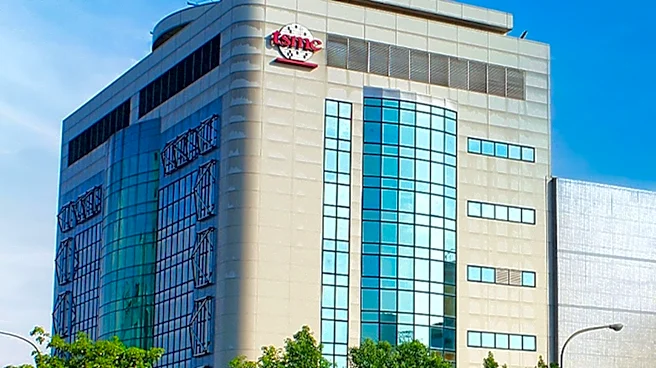
downturn, ARM Holdings reported a record revenue quarter, with its data center royalties doubling. CEO Rene Haas remains highly optimistic about the company's first in-house chip, the AGI CPU. Haas informed Reuters that ARM has secured sufficient supply from manufacturers like TSMC to achieve $2 billion in sales from the AGI CPU across fiscal years 2027 and 2028. He stated, 'We think the two (billion) is now very achievable.' The company's fiscal second-quarter revenue, ending September 30, exceeded expectations, rising 27% to $1.44 billion, with license and other revenue jumping 50% to $773 million. However, royalties grew only 8% to $670 million, falling short of analyst expectations, primarily due to pressure on phone royalties. ARM's stock is currently trading at approximately 70x forward earnings, which is below its three-year average of 86x.
Why It's Important?
The performance and future outlook of ARM Holdings are significant for the U.S. technology and semiconductor industries. As a key player in chip design, ARM's success or struggles can ripple through the entire tech ecosystem, affecting manufacturers, cloud service providers, and device makers. The CEO's confidence in achieving $2 billion in AGI CPU sales signals a potential shift in the data center market, where ARM-based chips are rapidly gaining traction. This could intensify competition with established players like Intel and NVIDIA, influencing market shares and technological innovation in server CPUs. The increasing adoption of ARM-based chips in data centers, projected to exceed 60% by the end of 2026 among top cloud companies, indicates a strategic pivot that could lead to more diverse and efficient computing solutions. For investors, the current valuation, below its historical average, presents a potential long-term buying opportunity, despite short-term volatility driven by broader market trends. The company's ability to secure supply from major foundries like TSMC is crucial for its growth ambitions and the broader supply chain stability in the semiconductor sector.
What's Next?
The immediate next step for ARM Holdings will be its early-February report, which will serve as a crucial test for investor confidence and provide further insights into the company's financial health and future projections. Analysts will closely monitor royalty revenues, especially from phone sales, and the continued growth in data center royalties. The company's ability to maintain its supply chain for the AGI CPU will also be a key factor in achieving its $2 billion sales target for fiscal 2027 and 2028. Furthermore, the ongoing competition in the server CPU market will be a significant area to watch, as ARM aims to expand its market share against rivals. Any further developments regarding potential approaches from companies like NVIDIA for CEO Rene Haas's position could also influence market sentiment. The consensus price target for ARM has recently slipped, but it still remains significantly above the last closing price, suggesting analysts see considerable upside potential. Investors will be looking for sustained growth in earnings per share, which analysts expect to more than double from fiscal 2026 to 2029.
Beyond the Headlines
Beyond the immediate financial metrics, ARM Holdings' strategic direction with its AGI CPU has broader implications for the future of computing and artificial intelligence. The push for in-house chip development signifies a move towards greater control over performance and efficiency, which is critical for advanced AI workloads. This could lead to a more diversified and resilient semiconductor industry, reducing reliance on a few dominant architectures. The increasing adoption of ARM-based chips in data centers also highlights a trend towards more energy-efficient computing, which is vital for addressing environmental concerns related to the massive power consumption of data centers. Ethically, the development of powerful new CPUs like the AGI could accelerate advancements in AI, raising questions about responsible AI development and deployment. Legally, intellectual property and licensing agreements will remain central to ARM's business model, especially as it expands its own chip offerings. The company's ties to SoftBank and any potential changes in ownership or strategic partnerships could also reshape its long-term trajectory and influence the competitive landscape of the global semiconductor industry.