



What's Happening?
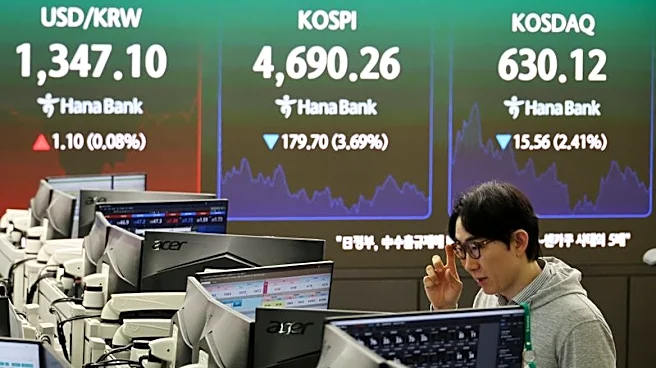
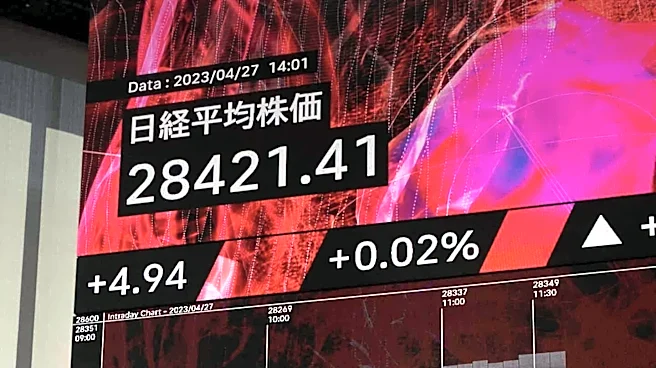
Asian stock markets experienced significant declines on Monday, driven by renewed selling in technology and semiconductor shares. This downturn has intensified concerns regarding AI valuations and the substantial debt financing data-center investments.
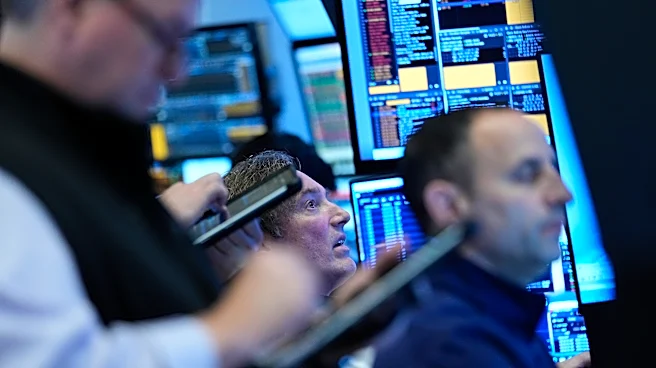
South Korea's KOSPI plunged 5%, Hong Kong's Hang Seng fell 1.5%, and Taiwan's Weighted Index saw a 0.5% rise despite a 17% weekly plunge. This follows a challenging week for U.S. markets, where the S&P 500 entered correction after seven consecutive losses, the Dow fell 1.9%, and the Nasdaq sank 5.3%, turning negative for 2026. Nvidia tumbled 14%, Anthropic dropped 8.5% on its second day of trading, and the Philadelphia semiconductor index fell approximately 11%. Despite the Asian market slide, Nasdaq 100 futures gained 2.5% and S&P 500 futures advanced 2% in Asian trade, indicating a potential rebound for U.S. equities.
Why It's Important?
The deepening rout in AI and semiconductor stocks, particularly in Asia, signals a significant re-evaluation of technology valuations globally. The substantial weekly losses in major U.S. indices like the S&P 500, Dow, and Nasdaq, which were the steepest since April 2025 and March 2020 respectively, highlight a broader market anxiety. The VIX reaching its highest level since April 2025 underscores increased market volatility and investor uncertainty. The concerns about debt-funded data-center builds and their ability to justify valuations, coupled with high-profile events like Jensen Huang's departure from Nvidia and Anthropic's weak post-IPO performance, suggest a potential shift in investor sentiment away from the previously booming AI sector. This could impact U.S. technology companies and their suppliers, potentially leading to reduced investment and slower growth in the sector.
What's Next?
Authorities in some Asian markets are implementing measures to stabilize the selloff. Taiwan has tightened short-selling rules and is actively buying shares, while South Korea is preparing to activate a stabilization fund and ease share-buyback limits. These actions indicate a proactive approach to mitigate further market declines. For the U.S. market, the rebound in futures suggests that investors may be looking for buying opportunities after the recent sharp declines. However, the underlying concerns about AI valuations and debt financing remain. The performance of U.S. technology and semiconductor stocks in the coming days will be crucial in determining if the recent downturn was a temporary correction or the beginning of a more sustained re-evaluation of the sector. Investors will closely monitor corporate earnings and economic indicators for further direction.
Beyond the Headlines
The current market dynamics highlight a broader re-assessment of the 'AI rally' that has significantly boosted technology stocks. The skepticism regarding debt-funded data-center investments and the ability of these ventures to generate sufficient returns to repay lenders or justify high valuations points to a potential shift in investment criteria. This could lead to a more cautious approach to funding high-growth, high-valuation technology companies, particularly those heavily reliant on AI. The increased market volatility, as indicated by the VIX, suggests a period of heightened risk aversion. This environment may favor companies with strong fundamentals and clear profitability pathways over those with speculative growth prospects, potentially reshaping the landscape of technology investment and innovation in the U.S. and globally.