





What's Happening?
Wayne State University's James and Patricia Anderson College of Engineering is actively preparing students for the evolving landscape of AI-driven manufacturing in Michigan. Through hands-on experiments at IntelliMake, a new research hub and pilot-scale
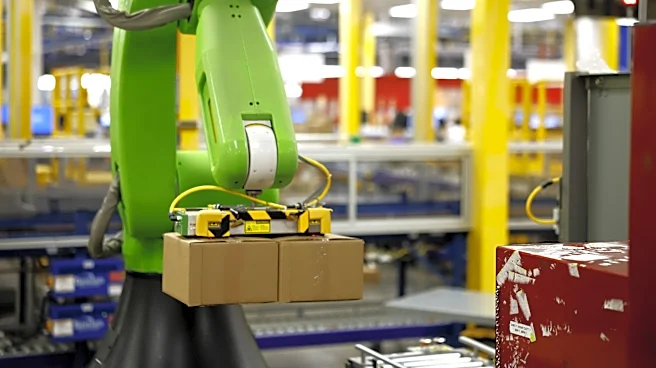
factory developed in partnership with Kyndryl, students are gaining practical experience with technologies like robots, conveyor systems, machine vision, and generative AI. This initiative aims to make manufacturing processes smarter, more flexible, and more efficient. Dr. Ratna Babu Chinnam, professor and chair of industrial and systems engineering and co-director of IntelliMake, highlights that the program bridges the gap between theoretical AI knowledge and real-world application. Students learn to give automated systems greater flexibility and autonomy, moving beyond traditional programmed movements to intelligent responses to changing conditions. The program is already yielding results, with graduates securing positions at leading companies like Panasonic, demonstrating the direct applicability of their learned skills.
Why It's Important?
This initiative is crucial for Michigan's economy, where manufacturing remains a central pillar. The state's AI and Workforce Plan estimates that 75% of manufacturing jobs will require upskilling due to the increasing prevalence of artificial intelligence and automation. Responsible AI adoption could generate up to $70 billion in economic impact and support 130,000 jobs. Wayne State's program directly addresses this workforce challenge by creating a pipeline of engineers equipped to translate AI advancements into practical improvements on the factory floor. By providing hands-on experience, the university ensures that students understand not only the capabilities but also the limitations of these technologies, preparing them to solve current and future manufacturing problems. This proactive approach helps Michigan maintain its competitive edge in the manufacturing sector and ensures a skilled workforce for the future.
What's Next?
Wayne State University plans to expand the IntelliMake facility and its educational approach to include additional areas such as modern quality control, production control, facilities design, and operational optimization. This expansion will further broaden the scope of practical AI application for students. The program also caters to working professionals seeking to update their skills, with a significant portion of students in courses like IE 6000: Digital Automation already being engineers or professionals from automotive companies. This continuous upskilling will be vital as AI technologies continue to integrate into various industries. The ongoing development of IntelliMake and its curriculum will ensure that Michigan's manufacturing sector has access to a highly skilled workforce capable of navigating rapid technological changes and implementing AI-driven solutions.
Beyond the Headlines
The shift towards AI-powered manufacturing, as exemplified by Wayne State's program, signifies a broader transformation in the nature of work and education. It underscores the increasing demand for interdisciplinary skills that combine computer science with engineering and practical application. The emphasis on hands-on experience in a controlled environment like IntelliMake allows for experimentation and innovation without disrupting live production, fostering a culture of continuous learning and problem-solving. This model could serve as a blueprint for other regions and industries facing similar technological shifts, highlighting the importance of collaboration between academia and industry to address future workforce needs. The ethical implications of increased automation and AI autonomy in manufacturing, such as job displacement and the need for new human-AI collaboration models, will also become increasingly relevant.