



What's Happening?
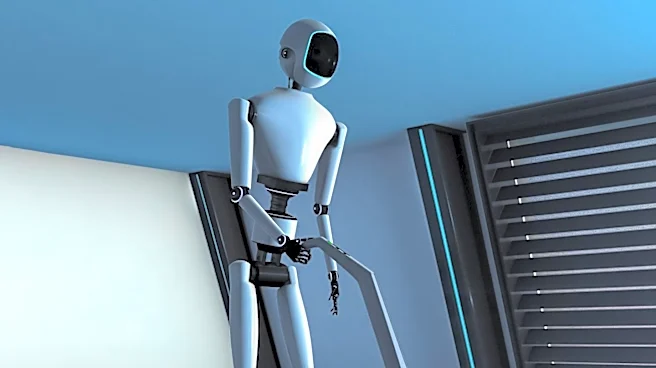
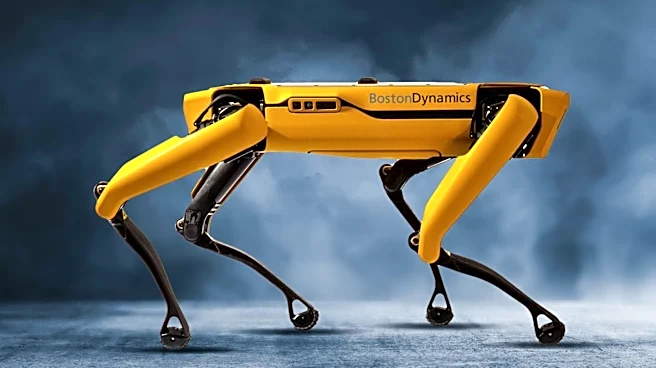
Boston Dynamics has opened a new Robotics Metaplant Application Center (RMAC) within Hyundai Motor Group’s Metaplant America campus near Savannah, Georgia. This center is dedicated to training Atlas humanoid robots for integration into Hyundai’s vehicle
manufacturing operations. The Atlas robots are currently being trained in real-world conditions for logistics work, specifically sequencing automotive parts for assembly. By 2030, Boston Dynamics aims to expand Atlas's role to include component assembly, repetitive motions, and heavy lifting. Hyundai Motor Group plans to deploy 25,000 Atlas units across its global Hyundai Motor and Kia plants in the coming years and intends to build a new U.S. production facility capable of manufacturing 30,000 robots annually. This initiative follows the unveiling of Atlas at CES 2026, where Hyundai Motor Group outlined its broader AI robotics strategy.
Why It's Important?
This development signifies a major step forward in the industrial application of advanced robotics and AI within the U.S. manufacturing sector. The integration of Atlas humanoid robots into Hyundai's production lines could revolutionize automotive manufacturing by increasing efficiency, reducing labor costs, and improving safety for tasks that are repetitive or strenuous for human workers. The planned deployment of 25,000 Atlas units and the construction of a new U.S. robot production facility highlight a significant investment in domestic robotics infrastructure and a commitment to 'physical AI at enterprise scale,' as stated by Zack Jackowski, Chief Product and Technology Officer at Boston Dynamics. This move could set a precedent for other industries, potentially leading to widespread adoption of humanoid robots in manufacturing, logistics, and other sectors, thereby impacting employment trends, skill requirements, and overall industrial productivity in the U.S.
What's Next?
Boston Dynamics plans to move RMAC operations into a facility roughly ten times its current size next year, indicating a rapid expansion of its training and development capabilities. The company is also exploring applications for Atlas beyond the automotive industry, engaging with existing customers in manufacturing, aerospace, semiconductors, logistics, food and beverage, and life sciences to scale data collection and continue training Atlas through 2027. This suggests a broader push for humanoid robot integration across various U.S. industries. The success of this initial deployment at Hyundai's Georgia plant will likely influence the pace and scope of future robotics adoption. Additionally, the establishment of a new U.S. robot production facility will contribute to job creation in the high-tech manufacturing sector and further solidify the U.S.'s position in advanced robotics.
Beyond the Headlines
The widespread adoption of humanoid robots like Atlas in manufacturing raises profound questions about the future of work and the human-robot interface. While proponents emphasize increased efficiency and safety, concerns about job displacement and the need for workforce retraining will become more prominent. This shift could accelerate the demand for skilled workers in robotics maintenance, programming, and AI development, while potentially reducing demand for manual labor in repetitive tasks. Furthermore, the integration of 'physical AI' on such a large scale could lead to new ethical considerations regarding human-robot collaboration, workplace dynamics, and the psychological impact of working alongside advanced humanoid machines. The U.S. will need to proactively address these societal and economic implications to ensure a smooth transition into a more automated industrial landscape.