






What's Happening?
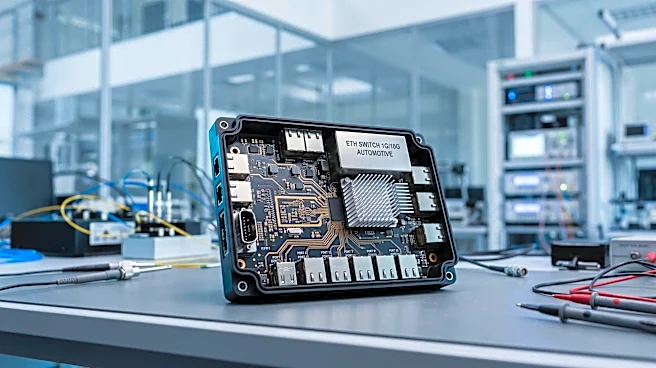
Microchip Technology has announced the sampling of its new LAN9324x and LAN9322x automotive-qualified Ethernet Time-Sensitive Networking (TSN) switch families. These new switch families are designed to provide turnkey switching solutions for next-generation
in-vehicle networks (IVN) as vehicle architectures transition towards centralized compute and zonal networking. The LAN932xx families are fully self-managed and configurable, aiming to reduce the need for customers to develop and maintain proprietary switch software. They utilize the VelocityDRIVE® Software Platform, which offers standards-based management through IETF/IEEE YANG data models and CORECONF for local or remote configuration, monitoring, and dynamic updates. This approach enables software and engineering reuse across compatible switches, simplifying development and validation processes.
Why It's Important?
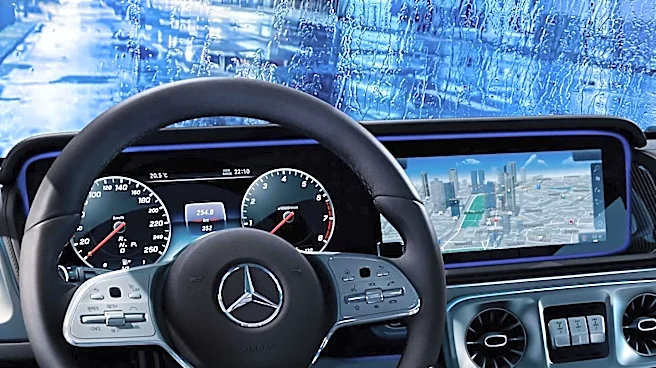
The introduction of these new Ethernet switch families is significant for the automotive industry's shift towards software-defined vehicles. As cars become more reliant on complex electronic systems, the in-vehicle network must be capable of real-time adaptation while maintaining deterministic performance, functional safety, and cybersecurity. Microchip's solution addresses these challenges by providing scalable hardware and dynamic runtime reconfiguration capabilities, allowing vehicle networks to respond to evolving safety, cybersecurity, and resource requirements. This innovation is crucial for accelerating the development and validation of advanced automotive systems, potentially leading to safer, more efficient, and more adaptable vehicles. The emphasis on standards-based software also promotes interoperability and reduces development costs for automotive manufacturers.
What's Next?
The sampling of the LAN9324x and LAN9322x switch families indicates that these products are moving closer to commercial availability for automotive manufacturers. As these switches become more widely adopted, they are expected to facilitate the broader implementation of software-defined vehicle architectures. The ability to dynamically reconfigure vehicle networks will support future advancements in autonomous driving, advanced driver-assistance systems (ADAS), and connected car technologies. Microchip's focus on reducing software development and maintenance efforts for customers suggests a trend towards more integrated and standardized solutions in automotive electronics. The continued evolution of these technologies will likely drive further innovation in in-vehicle networking, impacting how vehicles are designed, manufactured, and updated.
Beyond the Headlines
The shift towards software-defined vehicles, enabled by technologies like Microchip's new Ethernet switches, represents a fundamental change in automotive engineering. This paradigm move transforms vehicles from hardware-centric machines to software-driven platforms, opening up possibilities for over-the-air updates, personalized driving experiences, and new revenue streams for manufacturers. However, it also introduces complex challenges related to cybersecurity, functional safety, and the long-term maintenance of software systems. The reliance on advanced networking solutions like TSN is critical for ensuring that safety-critical functions operate reliably and securely. This evolution will necessitate new skill sets in the automotive workforce and could lead to a closer integration of automotive and software development industries, blurring traditional boundaries and fostering new ecosystems of innovation.