






What's Happening?
Merlin Labs, an aerospace and defense company specializing in autonomous flight technology, is actively seeking a Software Integration Engineer to join its Virtual Test Environments (VTE) team in Boston, MA. The role involves developing and maintaining
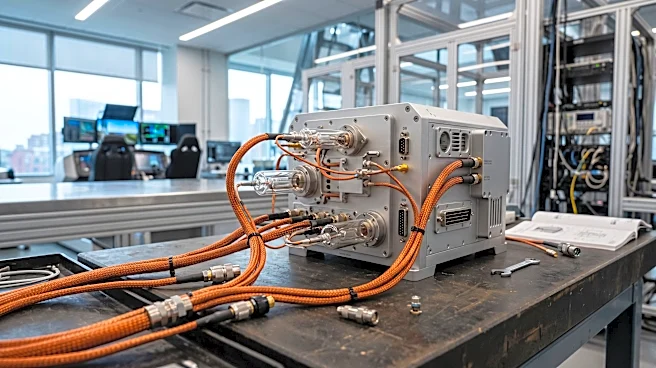
hardware-in-the-loop test environments and the associated software for data capture, display, and replay. The engineer will work with C++ and Python to connect aircraft avionics, simulation models, and test hardware, integrating various interfaces like ARINC 429, CAN, and serial. Responsibilities also include supporting real-time execution of aircraft simulation models, developing telemetry interfaces, and building operator displays and diagnostic tools. The position requires on-site work in Merlin's Boston lab to facilitate integration and troubleshooting of physical equipment. Merlin Labs is focused on advancing the certification and commercialization of its autonomy platform to address challenges such as pilot shortages and flight safety.
Why It's Important?
This hiring initiative by Merlin Labs underscores the ongoing advancements and investment in autonomous flight technology within the U.S. aerospace and defense sectors. The development of sophisticated hardware-in-the-loop test environments is crucial for ensuring the safety and reliability of autonomous aircraft systems before they are deployed in real-world scenarios. By expanding its engineering team, Merlin Labs aims to accelerate the development and deployment of its non-human pilot system, which could significantly impact the future of aviation. Success in this area could lead to increased operational efficiency, reduced reliance on human pilots, and enhanced flight safety across commercial and defense applications. The role's focus on integrating diverse software and hardware components highlights the complex interdisciplinary nature of modern aerospace engineering, requiring expertise in real-time systems, data acquisition, and avionics interfaces. This also signifies a growing demand for specialized software engineers in the autonomous systems domain.
What's Next?
Merlin Labs will continue to expand its team and accelerate the development and deployment of its autonomy platform. The successful candidate for the Software Integration Engineer position will contribute directly to the refinement and validation of Merlin's autonomous flight systems. This will involve ongoing integration of new technologies, rigorous testing in hardware-in-the-loop environments, and collaboration with various engineering teams to diagnose and resolve complex issues. The company is also focused on advancing the certification process for its autonomous flight technology, which will be a critical next step for broader commercial and defense adoption. As the technology matures, Merlin Labs will likely conduct more extensive flight tests from its global facilities, including the upcoming Bedford, Massachusetts location, to further validate the system's capabilities and reliability in diverse operational conditions.
Beyond the Headlines
The push for autonomous flight, exemplified by Merlin Labs' efforts, represents a significant paradigm shift in aviation with profound long-term implications. Beyond addressing pilot shortages, the widespread adoption of autonomous systems could redefine air travel, logistics, and military operations. Ethical considerations surrounding the role of artificial intelligence in critical decision-making during flight, particularly in unforeseen circumstances, will become increasingly prominent. Legally, regulatory frameworks will need to evolve rapidly to accommodate certified autonomous aircraft, addressing liability, air traffic control integration, and international standards. Culturally, public acceptance of non-human piloted aircraft will be a key factor, requiring extensive education and demonstrated safety records. This technological advancement could also spur innovation in related fields, such as advanced sensor technology, cybersecurity for aviation systems, and new forms of air mobility, potentially leading to a complete transformation of the aerospace industry.