
What's Happening?
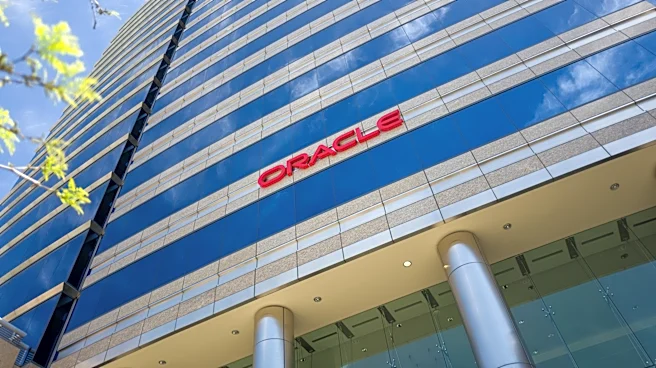
Oracle Corporation has confirmed it has secured funding for its extensive AI infrastructure program. This program includes its contract with OpenAI and the development of major U.S. data center campuses,
which are nearing completion. This funding announcement directly addresses previous investor concerns regarding Oracle's heavy borrowing, potential cash flow pressures, and the concentration risk associated with its AI partner ecosystem. The company's strategy involves leveraging significant AI and cloud infrastructure investments to transform its substantial revenue and software base into a larger, recurring stream of cloud and AI services. Oracle also recently launched Life Sciences AI Agents on November 18, demonstrating its commitment to integrating AI infrastructure with high-value software in regulated sectors. This move aims to diversify Oracle's AI revenue beyond its OpenAI-linked workloads and into its Oracle Health and life sciences customer base.
Why It's Important?
This funding is crucial for Oracle as it alleviates immediate financial concerns related to its ambitious AI infrastructure buildout. By securing the necessary capital, Oracle can proceed with its plans to expand its AI capabilities, which are central to its long-term growth strategy. The successful execution and utilization of this new capacity will be key to demonstrating a return on investment. For investors, the focus will now shift to how effectively Oracle can translate its fully funded AI infrastructure, particularly its OpenAI-related capacity, into healthier free cash flow and reduced reliance on further borrowing. The diversification of AI revenue streams, as evidenced by the Life Sciences AI Agents, is also significant. It suggests a broader application of Oracle's AI investments beyond a single hyperscale customer, potentially reducing risk and expanding its market reach within the enterprise software sector.
What's Next?
The immediate next steps for Oracle involve the effective execution and utilization of its newly funded AI infrastructure, especially the OpenAI-related capacity and the completion of its U.S. data center campuses. Investors will closely monitor upcoming quarterly reports for signs that AI infrastructure investments are translating into improved free cash flow and a decreased need for additional borrowing. The adoption and regulatory alignment of new AI products, such as the Life Sciences AI Agents, will also be critical to diversifying Oracle's AI revenue. Success in these areas would strengthen Oracle's position in the AI market and reduce its dependence on a single major partner. Any disruptions to its partnership with OpenAI or slower-than-anticipated capacity ramp-up could refocus investor attention on the company's balance sheet and debt levels.
Beyond the Headlines
Beyond the immediate financial implications, Oracle's substantial investment in AI infrastructure and its partnership with OpenAI highlight a broader trend in the technology sector: the race to dominate AI computing power. This move positions Oracle as a significant player in providing the foundational infrastructure necessary for advanced AI development. The company's strategy to integrate AI into specialized verticals like life sciences also points to the increasing demand for industry-specific AI solutions, moving beyond general-purpose AI. This could lead to deeper technological integration within regulated industries, potentially transforming workflows and accelerating innovation in fields like clinical trials. The long-term success of Oracle's AI strategy could influence the competitive landscape of cloud computing and AI services, potentially shifting market dynamics as companies vie for leadership in this rapidly evolving technological frontier.