



What's Happening?
Volkswagen Group reported its steepest quarterly loss in over a decade, an operating loss of €5.9 billion for July to September 2026. This significant deficit was primarily driven by an €8 billion one-off charge, including a €6.4 billion depreciation
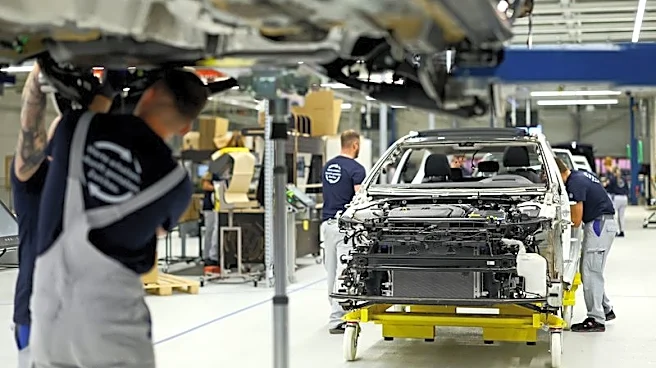
on its stake in Porsche, largely due to difficulties in the Chinese market. The company's CFO, Arno Antlitz, emphasized the urgent need for a sweeping restructuring plan, which includes 100,000 job cuts across the group and the closure of up to four plants in Germany. Volkswagen also plans to halve its model portfolio and reduce production capacity to achieve €31 billion in cost savings by 2030. The company's financial performance has prompted management to renew calls for radical cost cuts, as it grapples with shrinking margins and increased competition from Chinese electric-vehicle makers.
Why It's Important?
This development is critical for the global automotive industry, particularly for European automakers, as it highlights the intense competitive pressure from Chinese electric vehicle manufacturers. Volkswagen's struggles in China, a once highly profitable market, signal a significant shift in global automotive power dynamics. The planned job cuts and plant closures in Germany will have substantial economic and social impacts, affecting thousands of workers and potentially leading to broader economic ripple effects in the region. The company's strategic pivot towards increasing exports from China to offset slowing local demand, and its focus on developing technologies within China for global competitiveness, indicates a fundamental reshaping of its business model. This could influence other international automakers to re-evaluate their strategies in the face of evolving market conditions and rising Chinese dominance in EV technology.
What's Next?
Volkswagen's restructuring plan, which includes 100,000 job cuts and plant closures, is expected to be implemented rapidly. The company aims to achieve €31 billion in cost savings by 2030 through these measures, alongside reducing its model portfolio and production capacity. Volkswagen is also focusing on its 'In China for the entire world' strategy, planning to produce 300,000 cars annually in China for export to Asia, the Middle East, and South America. The company's Anhui venture, currently operating at a loss, is targeted to return to at least break-even by 2030. Further measures may be necessary if the business in China and the competitive landscape do not improve, potentially leading to additional write-downs in the future, according to Moritz Kronenberger of Union Investment.
Beyond the Headlines
The challenges faced by Volkswagen Group extend beyond immediate financial losses, reflecting a deeper structural shift in the global automotive landscape. The decline of Volkswagen's dominance in China, coupled with the rise of domestic Chinese EV brands, underscores a broader trend of technological innovation and market leadership shifting eastward. This situation raises questions about the long-term viability of traditional automotive manufacturing models and the need for rapid adaptation to new technologies and consumer preferences. The company's strategy to leverage Chinese-developed technologies globally suggests a potential future where innovation hubs are increasingly decentralized, with significant implications for intellectual property, supply chains, and international trade relations. The ethical considerations surrounding large-scale job cuts and plant closures in Germany, while necessary for financial stability, will also be a significant point of public and political debate.