








What's Happening?
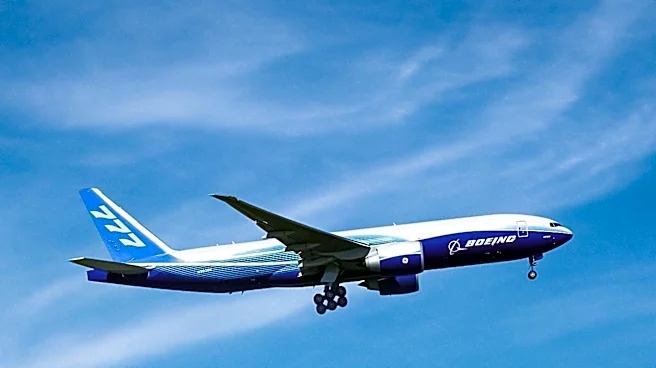
The Federal Aviation Administration (FAA) has granted Boeing an exemption that will allow up to 35 new 777 Freighters (777Fs) to receive their initial FAA airworthiness certificates starting in 2028. This decision, posted to the public docket on September
16, addresses a specific regulatory cutoff: newly built jets that do not meet certain fuel-efficiency limits cannot receive an original airworthiness certificate from January 1, 2028. The rule does not affect aircraft already in service. Boeing sought this relief to maintain 777F production until the next-generation 777-8F becomes available, which is expected around 2029. The FAA acknowledged that the current 777F model cannot meet the new limits and described the exemption as a way to serve existing customers during this transition. Boeing delivered two 777Fs in August and has 38 unfilled orders for the model.
Why It's Important?
This FAA exemption is critical for the air cargo industry and Boeing's production continuity. Without it, a significant gap in the availability of large widebody freighters could emerge, impacting global supply chains and the ability of cargo carriers to meet demand. The 777F is currently the only large widebody freighter in production, making its continued availability essential until the 777-8F is ready. For Boeing, the exemption allows it to fulfill existing orders and maintain its market position in the freighter segment, providing stability for its manufacturing operations and workforce. It also supports cargo carriers, many of which are U.S.-based, by ensuring they can continue to acquire necessary aircraft for their fleets. This decision highlights the FAA's role in balancing regulatory requirements with the practical needs of the aviation industry, particularly during periods of technological transition and new model development.
What's Next?
Boeing will proceed with the production and certification of up to 35 additional 777Fs under this exemption, ensuring a continuous supply for cargo carriers. Concurrently, the company will continue its development of the 777-8F, with the goal of its first delivery around 2029. The exemption provides a crucial bridge, but Boeing will need to manage the transition effectively to ensure a smooth shift to the newer model. Cargo carriers will likely utilize this opportunity to secure necessary aircraft, supporting their operational growth and modernization plans. The aviation industry will also be watching Airbus's progress with its competing A350F, which is expected to be certified and delivered by the end of 2027. The long-term implications will involve how quickly Boeing can bring the 777-8F to market and how the competitive landscape evolves with new freighter options.
Beyond the Headlines
This FAA decision reflects a broader challenge in the aerospace industry: the tension between advancing environmental regulations and the practical realities of aircraft development and production cycles. While the push for more fuel-efficient aircraft is vital for climate goals, the lengthy timelines for designing, testing, and certifying new models often necessitate interim solutions. The exemption for the 777F underscores the economic and logistical importance of maintaining current capabilities, especially in critical sectors like air cargo, which underpins global commerce. This situation also highlights the significant influence of regulatory bodies like the FAA in shaping market dynamics and supporting strategic industries. The balance struck here—allowing continued production of an older model while a newer, more compliant one is developed—is a common theme in industries undergoing rapid technological and environmental shifts, demonstrating the complex interplay between policy, innovation, and economic stability.