






What's Happening?
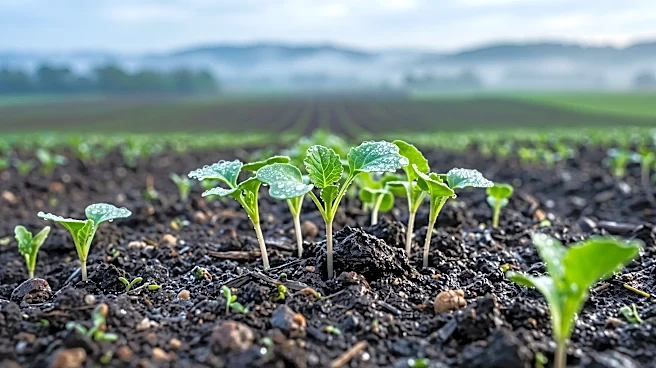
Farmers in regions like Illinois are increasingly adopting winter canola cultivation due to a new partnership that offers price certainty before planting. This initiative, involving Pioneer, Bunge, and Chevron, aims to mitigate the financial risks typically
associated with commodity markets. Unlike other crops where prices fluctuate, winter canola growers can lock in a per-bushel price in advance. For instance, Harrisburg, Ill., farmer Pervis Ellis, who returned to growing canola in 2025 after a long hiatus, secured a price of approximately $11.25 per bushel in 2026, which increased to $13.21 per bushel for the 2027 crop year. The partnership provides seed and agronomic assistance from Pioneer, Bunge purchases the grain, and Chevron, in collaboration with Bunge, processes it into oil for lower-carbon fuels, such as renewable diesel. This structured approach helps farmers manage risk and simplifies trade complexities, encouraging broader adoption of winter canola.
Why It's Important?
This development is significant for U.S. agriculture as it introduces a model that reduces financial uncertainty for farmers, potentially stabilizing income in a volatile market. The guaranteed pricing mechanism allows farmers to make more informed planting decisions, fostering greater economic security. Furthermore, the end-use of the canola oil in producing lower-carbon fuels aligns with growing environmental sustainability goals and the demand for renewable energy sources. This creates a new market for agricultural products that supports both farmer livelihoods and broader climate initiatives. The expansion of winter canola cultivation could also diversify crop rotations, offering agronomic benefits such as improved soil health and pest management, which are crucial for long-term agricultural sustainability in the U.S.
What's Next?
The partnership plans to significantly expand its reach, aiming for 300,000 to 400,000 acres of winter canola cultivation across the U.S. from an initial 5,000 acres, and establishing 18 delivery points. Bunge Chevron Ag Renewables (BCAR) is expanding its Destrehan, La., facility to process crops like winter canola, with the expanded section expected to open in the second half of 2026. This expansion will enable the crushing of winter canola in the Midsouth, which is not currently done. Chevron anticipates utilizing this oil as feedstock for renewable diesel production at its Geismar, La., facility. Farmers like Tim Kruckeberg, despite initial underwhelming yields, are continuing to plant canola, hoping for better weather and yields, and envisioning it replacing some cover crop acres.
Beyond the Headlines
The initiative highlights a broader trend towards integrating agricultural production with renewable energy supply chains, creating a symbiotic relationship between farming and industrial sectors. This model could serve as a blueprint for other agricultural commodities, potentially leading to more stable and predictable markets for farmers. The focus on lower-carbon fuels also underscores the increasing pressure on industries to adopt sustainable practices, driving innovation in both agriculture and energy. The guaranteed price structure challenges traditional commodity market dynamics, offering a potential paradigm shift in how agricultural products are valued and traded, and could influence policy discussions around agricultural subsidies and risk management programs.