





What's Happening?
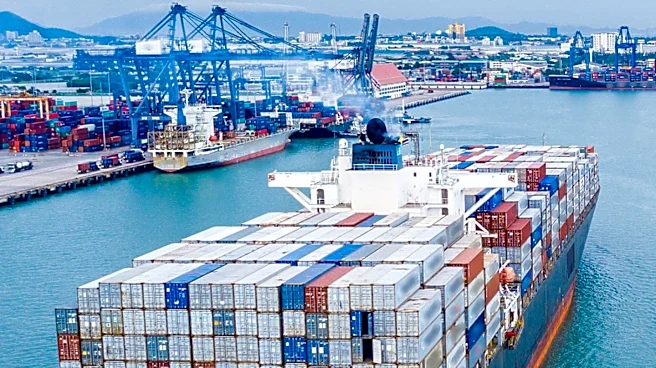
The Middle East, particularly the Gulf region, is strategically transforming its role in global maritime trade by developing 'Connected Trade Corridors.' This initiative aims to establish the region as a high-capacity interconnector and resilience hub
linking Asia, Africa, and Europe, moving beyond sole reliance on traditional East-West shipping lanes. The shift is a direct response to geopolitical volatility, climate-driven route disruptions, and evolving trade policies that necessitate more resilient and integrated networks. DP World's whitepaper, 'Navigating the Future of Maritime Trade,' highlights this strategy, which involves combining deep-sea shipping, shortsea feeder networks, ports, inland transport, and digital intelligence. For example, DP World activated alternative UAE gateways at Khorfakkan and Fujairah, supported by inland bonded transport and enhanced rail links, to bypass critical chokepoints like the Red Sea and the Strait of Hormuz while maintaining Jebel Ali as the primary hub. This approach creates operational redundancy and flexible routing options for cargo owners.
Why It's Important?
This development is crucial for global trade as it addresses the increasing fragility of traditional supply chains exposed to geopolitical tensions and environmental challenges. By establishing the Middle East as a central resilience hub, the initiative aims to ensure continuity of trade flows, reducing the impact of disruptions in critical waterways. The focus on 'Connected Trade Corridors' signifies a fundamental shift from cost-optimized, single-route supply chains to more robust, integrated networks. This strategy benefits industries worldwide by providing more reliable and diversified shipping options, potentially mitigating risks associated with delays and increased costs. Furthermore, the expansion of South-South trade, particularly between Asia and Africa, is being facilitated by the Middle East's multi-gateway networks, positioning the region as an essential bridge for these growing markets. The integration of digital intelligence, including AI, is vital for optimizing operations, predicting maintenance, and simulating alternative routes, enhancing the overall efficiency and adaptability of global logistics.
What's Next?
The Middle East is expected to continue investing in and expanding its multimodal infrastructure, including ports, rail links, and trucking fleets, to further strengthen its position as a global trade hub. The integration of advanced digital technologies, such as AI and platforms like the India-UAE MAITRI, will likely become more widespread to ensure seamless cross-border data exchanges and operational efficiency. Future developments will focus on deepening commercial ties with emerging markets, particularly in Africa, as these regions continue to drive global trade growth. The success of these connected corridors will serve as a model for other regions seeking to enhance supply chain resilience. Stakeholders, including logistics providers, governments, and businesses, will need to collaborate to ensure the effective implementation and continuous adaptation of these integrated trade networks to evolving global challenges.
Beyond the Headlines
The strategic pivot by the Middle East towards 'Connected Trade Corridors' reflects a broader global recognition of the need for supply chain resilience in an increasingly unpredictable world. This initiative goes beyond mere logistical improvements; it represents a fundamental rethinking of how international commerce operates, prioritizing flexibility and redundancy over singular efficiency. The emphasis on digital intelligence and AI in optimizing trade routes and operations highlights the growing role of technology in mitigating geopolitical and environmental risks. This shift could lead to a more distributed and interconnected global trade model, potentially decentralizing power from traditional trade chokepoints. Furthermore, the Middle East's role as a bridge between Asia and Africa underscores the evolving geography of global trade, with South-South trade becoming a significant driver of economic growth and regional integration. This transformation could foster new economic partnerships and reshape geopolitical alliances, emphasizing the importance of infrastructure and digital connectivity in the 21st century.