






What's Happening?
Brazil's logistics property market is undergoing a significant transformation, with the distance between warehouses and customers becoming a critical factor for investment. The growth of online retail, coupled with increasing consumer expectations for faster
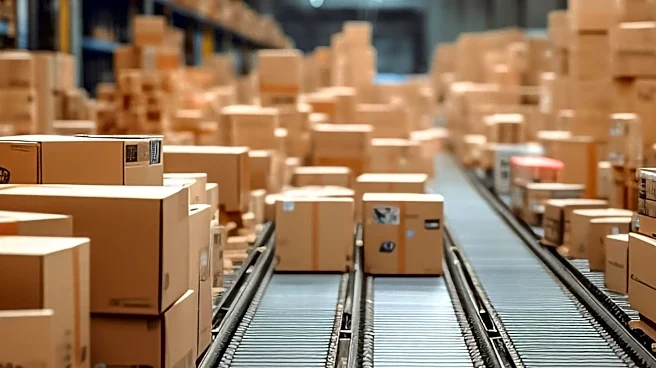
deliveries, is compelling logistics operators to re-evaluate their distribution strategies. Historically, the model involved large distribution facilities located along major highways outside metropolitan areas where land was cheaper. However, a new trend is emerging, particularly visible in São Paulo, where a second layer of logistics infrastructure is developing closer to consumers. This shift is driven by the need to reduce transportation times and costs in densely populated urban areas, which face challenges such as congestion, high land prices, and limited suitable development sites. Companies like Mercado Livre and Shopee are expanding their networks, influencing logistics submarkets by prioritizing rapid delivery over solely large-scale storage. This evolution means that while peripheral hubs remain crucial for national distribution, metropolitan facilities are gaining importance for last-mile delivery efficiency.
Why It's Important?
This evolution in Brazil's logistics sector has profound implications for property investors and urban planning. The economic value of logistics land is being redefined, with urban or near-urban sites, despite higher costs and less development capacity, becoming more attractive due to their ability to reduce delivery times for thousands of daily deliveries. This creates a scarcity problem for suitable logistics development land in urban areas, as it competes with residential and other commercial projects. The demand for modern building specifications, including sufficient ceiling heights, floor loading, loading docks, and technology infrastructure, is also increasing. This trend is segmenting Brazil's logistics market, where older warehouses in good locations may struggle to compete with newer, highly specified facilities. For investors, understanding a property's function within a distribution network, rather than just its prime versus secondary status, is becoming crucial. This shift is not limited to São Paulo but is expected to influence other major Brazilian cities like Rio de Janeiro, Belo Horizonte, and Curitiba, creating new demand for metropolitan warehouse locations where institutional logistics investment has historically been thinner.
What's Next?
The Brazilian logistics market is expected to become more segmented, with future investment portfolios likely combining national fulfillment hubs, regional warehouses, and smaller metropolitan facilities. This diversification could impact valuations, as properties that significantly reduce transportation time may command higher occupancy costs. Developers are exploring solutions like multi-level warehouses, common in densely populated Asian markets, to maximize usable floor area on expensive urban sites. The focus will increasingly be on network efficiency rather than just warehouse capacity or cheap land. As e-commerce companies extend faster delivery services beyond São Paulo, logistics operators will need to build infrastructure capable of supporting these promises in other major cities. This will likely lead to increased demand for metropolitan warehouse locations in cities like Rio de Janeiro, Belo Horizonte, and Curitiba, and in northeastern metropolitan areas such as Recife, Fortaleza, and Salvador. The investment case for logistics properties will increasingly be assessed site by site, considering factors like accessibility, road congestion, labor availability, building specifications, and proximity to population, with delivery time becoming a more critical metric than distance.
Beyond the Headlines
The transformation of Brazil's logistics landscape highlights a broader global trend driven by the 'on-demand' economy and consumer expectations for instant gratification. This shift has significant urban planning and environmental implications. The increased demand for urban logistics facilities could lead to greater pressure on urban land use, potentially impacting housing affordability and green spaces. Conversely, it could also spur innovation in urban logistics, such as the development of more compact, multi-story warehouses and the adoption of sustainable delivery methods. The emphasis on speed and efficiency also raises questions about labor practices in the delivery sector, as companies strive to meet ever-tightening delivery windows. Furthermore, the need for advanced technology infrastructure in warehouses points to the increasing integration of automation and data analytics in logistics, which could reshape the workforce and require new skill sets. This evolution underscores the complex interplay between technological advancement, consumer behavior, urban development, and economic strategy in a rapidly digitizing world.