



What's Happening?
In the current 'G-Zero' era, characterized by a weakened U.S.-led international order and the absence of a clear successor, global geopolitical risks and uncertainties are escalating, according to Ian Bremmer, chairman of the Eurasia Group. This environment
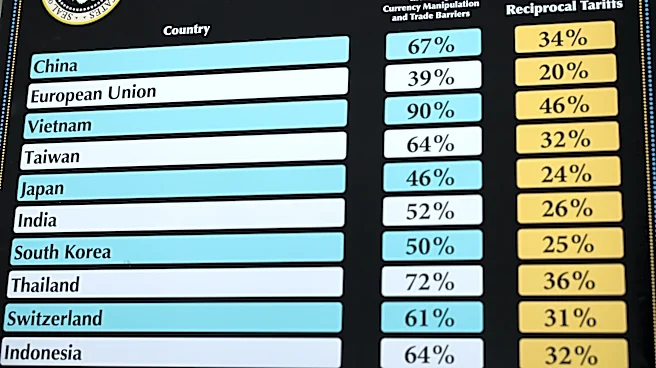
necessitates that companies develop robust strategies to navigate these shifts. During a CEO seminar, Gerard Dippo, chief economist at Eurasia Group, predicted that even after the U.S. midterm elections, South Korea will continue to face pressure to invest in the U.S. and expand cooperation in the shipbuilding industry. The relationship between the U.S. and China is expected to exhibit a 'managed decoupling,' prompting companies to establish systems for responding to rules of origin and export controls in both nations. Furthermore, the seminar highlighted new opportunities in the artificial intelligence (AI) and energy sectors, emphasizing the need for companies to refine investment and supply chain strategies in alignment with evolving national policies, including tariffs and export controls.
Why It's Important?
The 'G-Zero' environment significantly impacts U.S. industries and global economic stakeholders by introducing heightened uncertainty and risk. For U.S. companies, the 'managed decoupling' between the U.S. and China means navigating complex trade regulations and supply chain adjustments, potentially leading to increased operational costs or the need to re-shore production. The pressure on allies like South Korea to invest in the U.S. could benefit American industries, particularly in sectors like shipbuilding, by fostering greater collaboration and investment. However, it also underscores a broader trend where geopolitical considerations increasingly dictate economic decisions, potentially leading to less efficient global supply chains. The emphasis on AI and energy sectors as areas of opportunity suggests a strategic shift in global investment, with those who can quickly adapt to these new landscapes poised to gain. Conversely, companies unable to respond effectively to these geopolitical shifts risk losing competitiveness and market share.
What's Next?
Companies are advised to proactively refine their investment and supply chain strategies to align with the evolving policies of various countries, particularly concerning tariffs and export controls. This includes establishing robust systems to manage rules of origin and export controls in both the U.S. and China. In the AI sector, a 'hybrid system' is anticipated to emerge over the next two years, with Chinese open AI models spreading based on U.S. semiconductors and cloud infrastructure. Korean companies, in particular, are urged to reduce their dependence on specific AI suppliers and develop industry-specific AI solutions using manufacturing data. In the energy sector, high procurement costs are expected to persist until 2027 due to geopolitical conflicts, presenting opportunities for Korean companies as suppliers of non-national power grid facilities and in the expansion of large nuclear power plants and small modular reactors (SMRs). The need to expand infrastructure like GPUs and clouds, alongside establishing AI security and control systems, is also critical.
Beyond the Headlines
The 'G-Zero' era signifies a fundamental shift in global governance, moving away from a unipolar or even multipolar order towards a more fragmented and unpredictable landscape. This has profound implications beyond immediate business strategies, touching upon the very nature of international cooperation and the future of globalization. The increasing intertwining of geopolitical risk with corporate competitiveness suggests that traditional economic models, which often assume stable international relations, are becoming obsolete. This new reality could lead to a re-evaluation of corporate social responsibility, as companies may find themselves inadvertently supporting or undermining geopolitical objectives through their supply chain and investment decisions. Furthermore, the emphasis on AI and energy as strategic sectors highlights a broader technological and environmental race, where national security and economic prosperity are increasingly linked to advancements in these critical areas, potentially leading to new forms of international competition and collaboration.