





What's Happening?
China is facing a significant challenge as its debt-servicing payments are consuming an increasing portion of the central government's budget. According to new Conference Board estimates cited by the Financial Times, these payments are projected to account
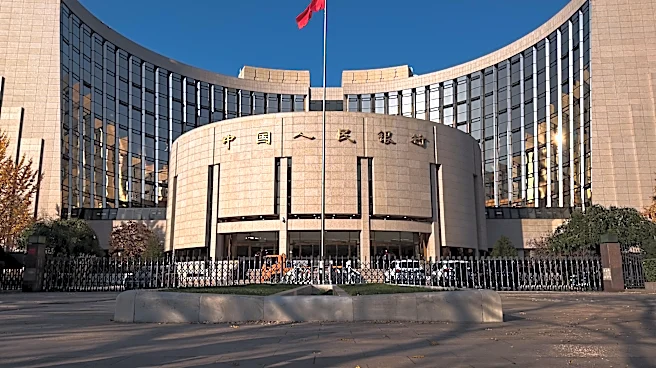
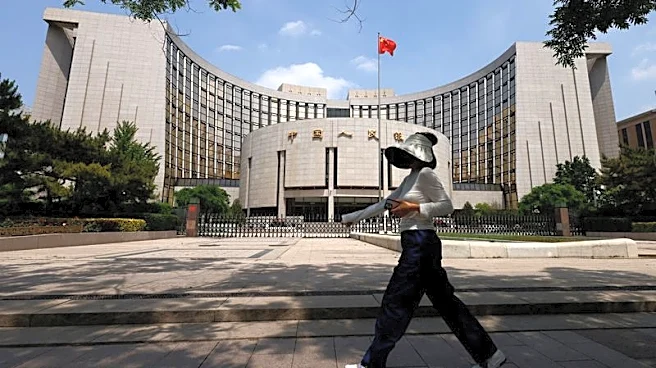
for 19.2% of the central government's general public budget this year, a substantial rise from 12% in 2014. This surge in interest costs is limiting Beijing's capacity to implement new economic stimulus measures at a time when its economy is decelerating. China's GDP growth is on track to fall below its annual target of 4.5% to 5%. The country is grappling with weak consumer spending, declining investment, an ongoing crisis in the property sector, and anemic stock market performance. Despite growth in export-facing sectors, trade partners are imposing barriers, further complicating China's economic outlook. The People's Bank of China, a government agency, is at the center of managing these financial challenges.
Why It's Important?
The escalating debt burden in China has critical implications for both its domestic stability and the global economy. The inability of the Chinese government to effectively stimulate its economy due to high interest costs could lead to prolonged economic stagnation. This situation is a direct consequence of years of state-directed borrowing aimed at propping up favored industries, which often resulted in misallocated capital. For instance, business debt has doubled since 2019, while revenues have only increased by 30%, leaving nearly a third of firms unprofitable. This misallocation of resources has sapped China's economic potential and highlights the long-term costs of politically driven economic decisions. A weakened Chinese economy could reduce global demand, impacting international trade and investment, and potentially creating ripple effects for U.S. businesses and financial markets that rely on China's economic health.
What's Next?
As China's debt-servicing costs continue to rise, the government will face increasing pressure to find alternative ways to stimulate its economy without exacerbating its fiscal challenges. This could involve a re-evaluation of its state-led growth model and a shift towards more market-oriented reforms. Creditors are currently rolling over loans to struggling firms, but this practice is unsustainable in the long term and could lead to a wave of defaults if economic conditions do not improve. Beijing may need to implement stricter lending standards and allow unprofitable businesses to fail, which could lead to short-term economic pain but potentially foster long-term stability. The international community will be closely watching China's response, as its economic trajectory will have significant implications for global financial stability and trade relations.
Beyond the Headlines
The current debt crisis in China underscores a fundamental tension between state-controlled economic planning and market efficiency. The practice of directing state banks to finance priority industries, such as electric vehicles, robotics, artificial intelligence, and renewable energy, while intended to foster growth, has inadvertently led to widespread misallocation of capital and a significant increase in non-performing loans. This 'double-down' strategy, akin to a gambler increasing bets after losses, has created a deep fiscal hole. The ethical implications of propping up failing businesses through continuous loan rollovers raise questions about transparency and accountability within China's financial system. This situation could trigger a re-evaluation of the sustainability of state-led economic models and potentially influence other developing economies considering similar approaches, highlighting the long-term risks associated with political interference in capital allocation.