






What's Happening?
D-Wave Quantum reported a 21% increase in third-quarter revenue on November 10, positioning itself as a potential leader in the quantum computing market over the next five years. While IonQ currently holds a market cap exceeding $14.3 billion, D-Wave Quantum's
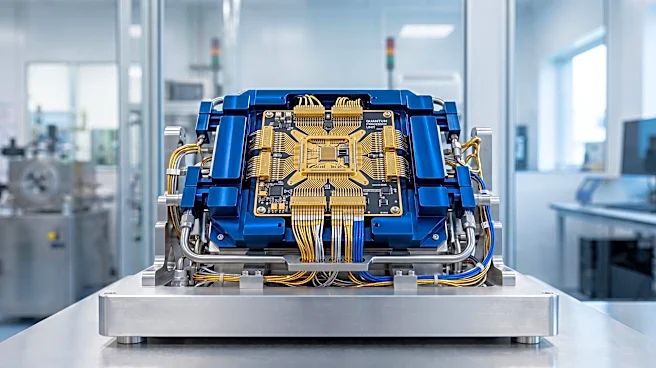
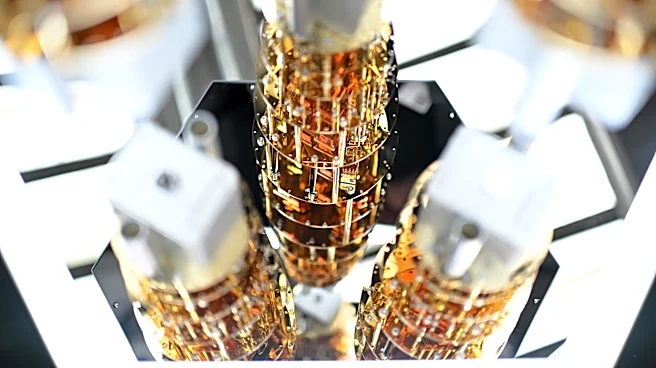
market cap stands at approximately $3.7 billion. D-Wave's approach to quantum computing is distinct, focusing on quantum annealing technology designed to solve specific optimization and sampling problems. This technology is already being applied to real-world issues for clients such as NTT DOCOMO, Japan's largest mobile carrier, which has deployed D-Wave's hybrid quantum technology in its network operations. The company has also expanded its presence in Europe by delivering an Advantage2 system to Italy. Furthermore, D-Wave's acquisition of Quantum Circuits provides a pathway to developing gate-model quantum computers, allowing it to pursue both annealing and gate-model approaches simultaneously to address a broader range of computational problems.
Why It's Important?
D-Wave's focus on solving real-world optimization and sampling problems with its quantum annealing technology provides a significant advantage in the nascent quantum computing industry. By delivering tangible solutions today, D-Wave is building commercial relationships and establishing a market presence before the broader quantum market fully matures. This strategy allows the company to generate revenue and gain practical experience, which could be crucial for long-term success. The expansion of partnerships, such as with NTT DOCOMO and CGI, demonstrates the growing applicability of D-Wave's technology in enterprise use cases. The acquisition of Quantum Circuits is a strategic move that broadens D-Wave's technological capabilities, enabling it to compete across a wider spectrum of quantum computing applications. This dual approach could position D-Wave to capture a larger share of the future quantum computing market, potentially surpassing competitors like IonQ in market valuation over the next five years, as suggested by some analysts.
What's Next?
D-Wave Quantum is expected to continue its dual-pronged approach, advancing both its quantum annealing technology and its newly acquired gate-model capabilities. The company has outlined an ambitious gate-model roadmap extending to 2032, focusing on dual-rail superconducting technology to build systems capable of complex computations. Further expansion of commercial partnerships and customer adoption will be critical for D-Wave's growth. The company's ongoing proof-of-technology project with SkyWater Technology in semiconductor manufacturing, which has already shown reductions in lot delays, indicates potential for broader implementation. While D-Wave faces risks associated with being an early-stage company, including volatile revenues and high R&D costs, its ability to demonstrate real-world problem-solving and expand its technological portfolio will be key indicators of its future success and potential to become a dominant player in the quantum computing industry.
Beyond the Headlines
D-Wave's strategic emphasis on immediate, real-world applications for its quantum annealing technology, alongside its pursuit of gate-model quantum computing, highlights a critical divergence in the quantum industry's development. While many companies focus on the long-term potential of universal gate-model quantum computers, D-Wave is demonstrating the commercial viability of specialized quantum solutions today. This approach could accelerate the adoption of quantum technologies by providing immediate value to industries facing complex optimization challenges. The success of D-Wave's strategy could influence how other quantum computing firms prioritize their development efforts, potentially leading to a more diversified market with both specialized and general-purpose quantum solutions. This also raises questions about the optimal path to quantum supremacy and commercial success, suggesting that practical, incremental advancements might be as impactful as revolutionary breakthroughs in the short to medium term.