




What's Happening?
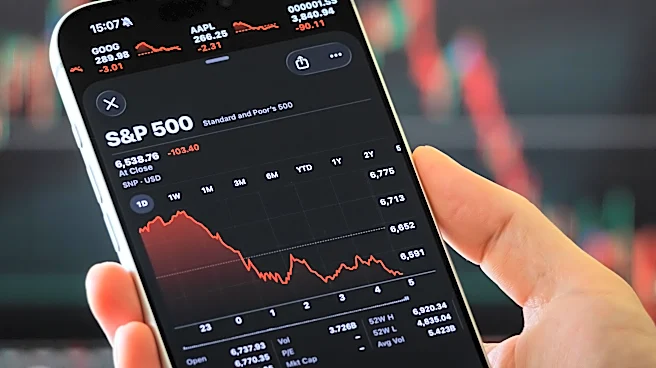
The S&P 500 index concluded Friday's trading session at 6,910.39, marking a 265.44-point decline. This closing figure places the index below every year-end price target set by major Wall Street firms for 2026. The SPDR S&P 500 ETF Trust (SPY) experienced
a 3.64% fall during the session, with the index now up less than 1% for the year. Over the past week, SPY lost 7.55%, and over the past month, it declined by 9.79%. The iShares Core S&P 500 ETF (IVV) and the Vanguard S&P 500 ETF (VOO) also saw significant weekly drops of 7.49% and 7.47%, respectively, mirroring SPY's performance due to their identical index holdings. The CBOE Volatility Index, a measure of market fear, closed Thursday at 28.44, indicating a 52.1% increase in volatility over the week. The index is currently 11.6% below its October record close of 7,818.93.
Why It's Important?
This significant downturn in the S&P 500 carries substantial implications for investors and the broader U.S. economy. The fact that the index has fallen below all Wall Street year-end targets suggests that previous market expectations may have been overly optimistic, potentially leading to a reassessment of future growth prospects. This could trigger increased caution among investors, leading to further market volatility and a potential shift towards more conservative investment strategies. The rising CBOE Volatility Index underscores growing market anxiety, which can deter new investments and prompt existing investors to liquidate holdings. For individual investors, particularly those nearing retirement, the erosion of gains could impact financial planning and withdrawal strategies. The performance of major ETFs like SPY, IVV, and VOO, which track the S&P 500, directly affects a vast number of portfolios, including retirement accounts and mutual funds, indicating a widespread impact across the financial landscape.
What's Next?
The immediate future for the S&P 500 will likely involve continued scrutiny of economic indicators and corporate earnings reports. With the index significantly below its average year-end target of 7,600, achieving a 10% rally by year-end, as suggested by Creative Planning's Charlie Bilello, appears challenging. Historical data indicates that only four years since 1970 have seen a 10% rally from November 20 to year-end, making such a recovery unlikely. Market participants will be closely watching for any signs of stabilization or further declines, which could influence monetary policy decisions by the Federal Reserve. Businesses may also adjust their investment and hiring plans in response to a more uncertain economic outlook. Investors are likely to re-evaluate their portfolios, potentially shifting towards less volatile assets or increasing their cash positions in anticipation of further market fluctuations.
Beyond the Headlines
The current market situation extends beyond immediate financial losses, hinting at deeper shifts in investor sentiment and economic forecasting methodologies. The collective misjudgment by Wall Street firms regarding year-end targets raises questions about the reliability of traditional market prediction models in an increasingly dynamic economic environment. This could lead to a re-evaluation of how financial institutions forecast market performance and manage risk. Furthermore, the sustained period of volatility might prompt a broader discussion on market resilience and the effectiveness of current regulatory frameworks in mitigating systemic risks. The psychological impact on retail investors, who may experience increased anxiety and distrust in market forecasts, could also be significant, potentially altering long-term investment behaviors and participation in equity markets. This period of uncertainty may also accelerate the adoption of more sophisticated analytical tools and alternative data sources for market analysis.