





What's Happening?
New research by Break Free From Plastic, Facing Finance, and FairFin reveals that major financial institutions globally provided nearly $220 billion in credit to four of the world's largest plastic-using consumer goods companies—Coca-Cola, PepsiCo, Nestlé,
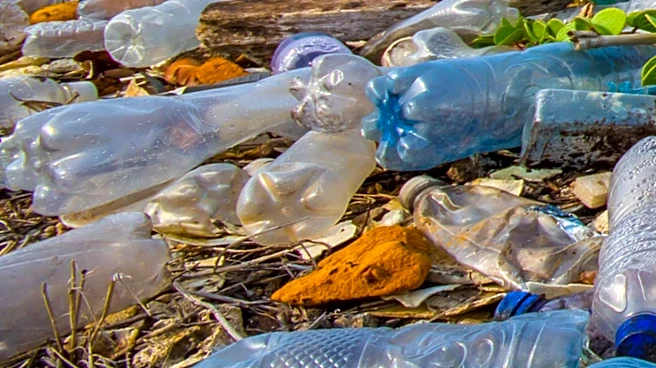
and Unilever—between January 2019 and May 2025. Additionally, these institutions held or managed $138 billion in shareholdings in these companies as of May 31, 2025. U.S. financial institutions, led by Bank of America, Citigroup, and JPMorgan Chase, accounted for $108.3 billion (49.4%) of this credit. European lenders, including HSBC, Deutsche Bank, and Barclays, provided $95.4 billion (43.5%). The report, titled 'Cashing In On Plastic,' highlights a significant disconnect between financial institutions' public commitments to climate action and sustainability and their continued financing of companies heavily reliant on single-use plastics. The environmental and health costs of plastic pollution are estimated to exceed $1.5 trillion annually, with projections indicating plastic pollution could more than double by 2040 without intervention.
Why It's Important?
This report is important because it exposes the substantial financial backing that fuels the global plastic pollution crisis, directly linking major financial institutions to the problem. The significant investment from U.S. financial institutions underscores their critical role in either perpetuating or mitigating plastic pollution. This financial support enables top polluters like Coca-Cola, PepsiCo, Nestlé, and Unilever to continue their plastic-intensive business models, despite growing environmental concerns and their own stated sustainability goals. The research suggests that financial institutions are not adequately assessing plastic production and use as a material financial risk, potentially exposing themselves to future liabilities related to environmental damage and public health impacts. This situation creates a systemic risk, as plastic production is closely tied to fossil fuel use, and its environmental costs are not fully internalized by corporations or their financiers. The findings call into question the sincerity and effectiveness of ESG (Environmental, Social, and Governance) commitments made by these financial entities.
What's Next?
The report calls for financial institutions to reassess their investment strategies and integrate plastic production and use as a material financial risk. It recommends that institutions set clear expectations and disclosure requirements for financed companies, scale up financing for reuse, refill, and low-waste business models, and strengthen internal policies to prevent the financing of plastic expansion through general corporate lending. Pressure from advocacy groups like Break Free From Plastic will likely intensify, urging these financial institutions to align their financing practices with their sustainability commitments. Regulators may also face increased calls to mandate greater transparency and accountability from financial institutions regarding their environmental impact. Companies like Coca-Cola, PepsiCo, Nestlé, and Unilever may face increased scrutiny from investors and consumers, potentially leading to demands for more aggressive plastic reduction targets and investments in sustainable packaging alternatives.
Beyond the Headlines
The findings reveal a deeper ethical dilemma within the financial sector: the tension between profit generation and environmental responsibility. While many financial institutions publicly commit to sustainability, their investment portfolios often contradict these pledges, highlighting a 'greenwashing' concern. This situation raises legal questions about fiduciary duties and whether financial institutions are adequately assessing long-term environmental risks that could impact shareholder value. Culturally, the continued financing of plastic polluters reflects a broader societal challenge in transitioning away from a linear 'take-make-dispose' economy. The report implicitly suggests that systemic change requires not only corporate responsibility but also a fundamental shift in how financial capital is allocated, moving towards investments that support a circular economy and genuinely sustainable practices. The long-term implications include potential stranded assets in plastic-intensive industries and increased regulatory pressure if the environmental costs of plastic pollution continue to escalate.