





What's Happening?
Nicholas Hoult takes on the lead role of Ryan in the new film 'How to Rob a Bank,' which premiered exclusively in theaters on November 13. Directed by David Leitch, known for 'The Fall Guy,' the movie centers on a group of bank robbers who livestream
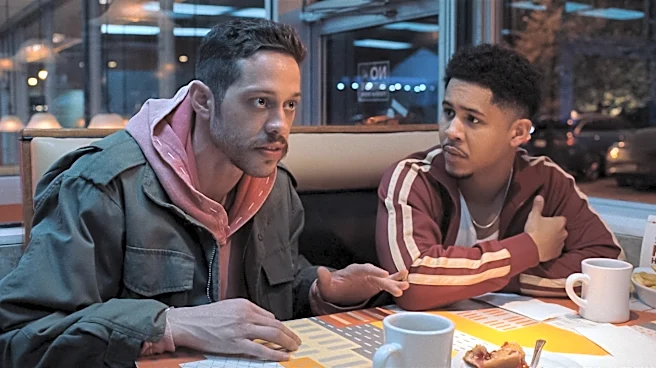
their heists and distribute the stolen money to the public. Hoult's character, Ryan, is depicted as a 'Marx-reading' leader of an anonymous crew that uses YouTube-esque explainer videos to detail their bank-robbing techniques. These videos, featuring gunmen in wolf masks, are interspersed with Go-Pro-style footage of their operations, aiming to educate and inspire an online following. The film also stars Anna Sawai as Emi, Pete Davidson as Vince, Rhenzy Feliz as Hugo, John C. Reilly as FBI agent John West, and Zoë Kravitz as tech-wiz Raegan. The narrative explores themes of anti-capitalism and societal grievances, with the robbers presenting their actions as a response to a system that primarily benefits the wealthy. The crew's motivations are rooted in personal tragedies, such as Vince being a war veteran, Hugo the son of undocumented immigrants, and Ryan and Emi losing their child due to an insurance scam.
Why It's Important?
This film is important as it reflects contemporary societal anxieties and the pervasive influence of social media. By portraying bank robbers as anti-capitalist influencers who gain a massive online following, the movie taps into a growing sentiment of distrust towards established financial systems and institutions. The narrative's focus on characters driven by 'familiar American grievances' suggests a commentary on economic inequality and the perceived failures of the government to protect ordinary citizens. The use of livestreaming and social media platforms within the plot highlights how digital tools can be leveraged to disseminate ideologies and mobilize public sentiment, even for illicit activities. This could resonate with audiences who feel marginalized or disenfranchised, potentially sparking discussions about economic justice and the ethics of 'taking back' from the powerful. The film's exploration of these themes through a heist genre lens offers a unique perspective on modern forms of rebellion and the blurred lines between crime and social activism in the digital age.
What's Next?
As 'How to Rob a Bank' has just been released, its immediate future involves its theatrical run and subsequent availability on streaming platforms, given its backing by Amazon. The film's reception, which has been described as 'annoyingly flashy' yet potentially 'one of the year’s biggest surprises,' will determine its commercial success and critical legacy. The movie's themes of anti-capitalism and social media influence could spark further public discourse on these topics, particularly among younger audiences who are more engaged with online culture. Depending on its popularity, the film might inspire similar productions that blend crime narratives with contemporary social commentary and digital media elements. The performances of its ensemble cast, including Nicholas Hoult, Zoë Kravitz, and Pete Davidson, could also influence their future roles and the types of projects they pursue.
Beyond the Headlines
Beyond its entertainment value, 'How to Rob a Bank' delves into deeper implications regarding the ethics of vigilantism and the power of narrative in the digital sphere. The film's portrayal of bank robbers as 'Robin Hood' figures who distribute stolen money to charities and 'underdeveloped groups' raises questions about the justification of illegal acts for perceived moral causes. This narrative challenges traditional notions of crime and justice, suggesting that public perception, heavily influenced by social media, can transform criminals into folk heroes. The movie also implicitly critiques the 'lousiest algorithm' of social media, highlighting how platforms can amplify certain messages, regardless of their legality or ethical standing. This could lead to broader discussions about media literacy, the responsibility of social media companies, and the potential for online movements to incite real-world actions, whether constructive or destructive. The film's 'Trump-era rationale' for the robbers' ambitions further underscores how political and social climates can fuel anti-establishment sentiments, making the story a timely reflection on contemporary American society.