







What's Happening?
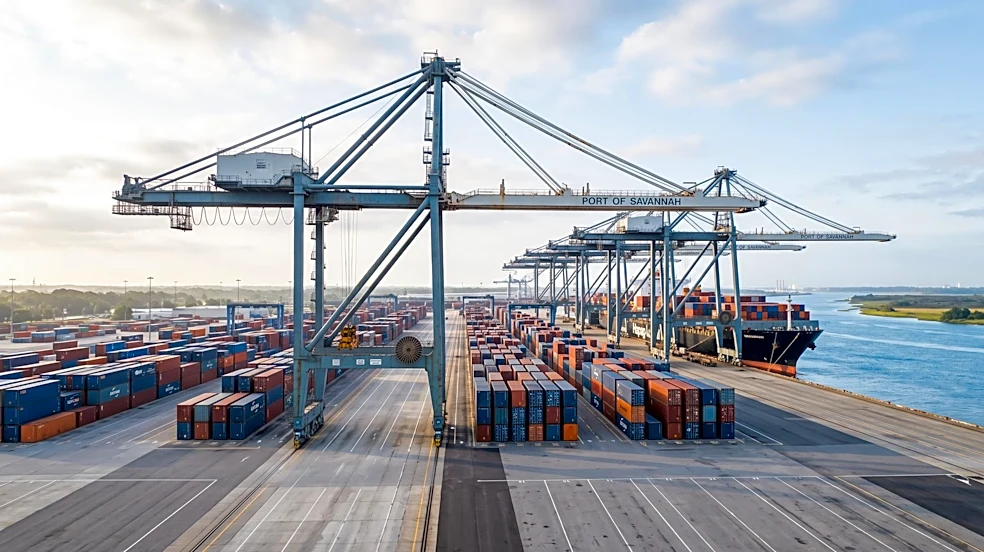
The Georgia Port Authority has received approval from the U.S. Army Corps of Engineers for a significant new container terminal at the Port of Savannah. This approval concludes a three-year review process. The new terminal will be constructed on 350 acres
of Hutchison Island and is projected to have a capacity of 3.5 million TEU (twenty-foot equivalent units). This expansion aims to sustain the port's growth, which has been ongoing since the inauguration of the New Panama Canal in 2016, facilitating 'all-water' routes from Asia to the U.S. East Coast. Currently, the Port of Savannah has a nameplate capacity of approximately 7.75 million TEU. Additionally, the port is investing around $1.6 billion to increase the capacity of its Ocean Terminal from 200,000 TEU to about 1.75 million TEU by 2028. The port authority, the state, and the Corps of Engineers are also collaborating on other projects, including a large-scale dredging project for Savannah Harbor, to accommodate larger vessel traffic and enhance intermodal transport infrastructure.
Why It's Important?
This expansion is crucial for maintaining the Port of Savannah's role as a key gateway for international trade on the U.S. East Coast. The added capacity will allow the port to continue its decade-long growth trajectory, which has seen its container volume nearly double and overall revenues more than triple since 2011 under CEO Griff Lynch. The increased capacity will improve efficiency and reduce potential bottlenecks in the supply chain, benefiting businesses that rely on the port for importing and exporting goods. This development also signifies continued investment in critical infrastructure, supporting economic activity and job creation in Georgia and the broader Southeast region. The ability to handle more cargo and larger vessels will enhance the competitiveness of U.S. logistics and trade, providing more options and potentially lower costs for shippers.
What's Next?
With the permit secured, the Georgia Port Authority can proceed with the development of the new container terminal on Hutchison Island. Construction will commence on the 350-acre site, aiming to add 3.5 million TEU to the port's capacity. Concurrently, work will continue on the $1.6 billion expansion of the Ocean Terminal, which is expected to be completed by 2028. Further projects to improve Savannah Harbor for larger vessel traffic and enhance shoreside infrastructure for intermodal transport, including a large-scale dredging project, will also advance. These initiatives are expected to solidify the Port of Savannah's position as a major logistics hub, accommodating future growth in trade volumes and supporting the evolving needs of global shipping. The progress on these projects will mark a significant achievement for CEO Griff Lynch's tenure.
Beyond the Headlines
The expansion of the Port of Savannah reflects a broader trend of increasing investment in U.S. port infrastructure to accommodate larger vessels and growing global trade volumes, particularly from Asia. This development highlights the strategic importance of East Coast ports following the expansion of the Panama Canal, which has shifted some shipping routes. The long-term implications include enhanced supply chain resilience for the U.S., potentially reducing reliance on West Coast ports and offering more diversified shipping options. Environmentally, large-scale port expansions and dredging projects often involve complex considerations regarding marine ecosystems and coastal habitats, necessitating careful planning and mitigation strategies. Economically, the sustained growth of the Port of Savannah could further establish Georgia as a logistics and distribution hub, attracting related industries and fostering regional economic development.