

What's Happening?
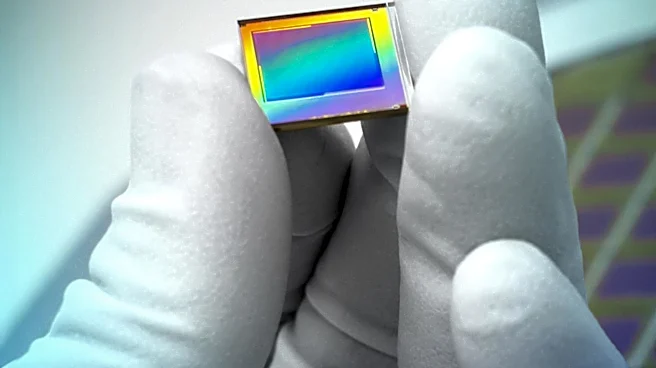
Advanced Micro Devices (AMD) has announced the acquisition of Taalas, a Toronto-based startup specializing in chips for AI inference. Taalas' technology focuses on creating accelerators that are hard-wired for specific AI models, offering a cost-effective
solution that can deliver outputs significantly faster than traditional GPUs. This acquisition is part of AMD's strategy to diversify its AI chip offerings, complementing its existing GPU lineup. The move follows a similar acquisition by Nvidia, which recently purchased assets from Groq, another AI chip designer. Taalas' current chip supports a version of Meta's Llama 3.1 model and is manufactured using an older process by Taiwan Semiconductor Manufacturing Co. AMD plans to integrate Taalas' technology into its product roadmap, enhancing its Helios rack-scale systems.
Why It's Important?
The acquisition of Taalas by AMD highlights the growing importance of specialized AI chips in the tech industry. As demand for AI capabilities increases, companies are seeking more efficient and cost-effective solutions to power AI applications. By acquiring Taalas, AMD aims to strengthen its position in the AI chip market, offering a broader range of products to meet diverse customer needs. This move could enhance AMD's competitiveness against rivals like Nvidia, which has also been expanding its AI chip portfolio. The integration of Taalas' technology into AMD's systems could lead to improved performance and cost savings for customers, potentially driving further adoption of AMD's AI solutions.
What's Next?
AMD plans to incorporate Taalas' technology into its existing product lines, including its Helios rack-scale systems. This integration is expected to enhance AMD's offerings in the AI chip market, providing customers with more tailored solutions for specific AI applications. As the demand for AI capabilities continues to grow, AMD's expanded product lineup could attract new customers and increase its market share. Additionally, the acquisition may prompt further consolidation in the AI chip industry, as companies seek to enhance their technological capabilities and remain competitive.