






What's Happening?
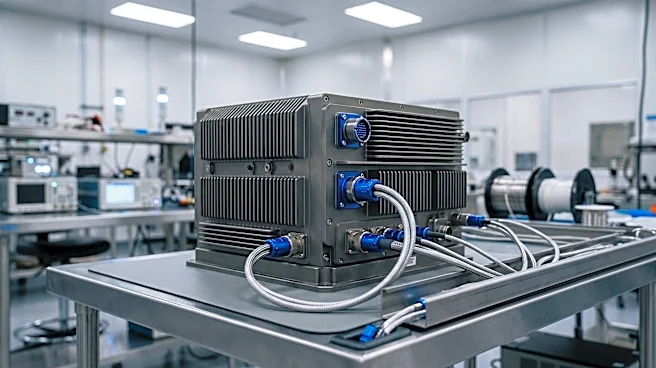
Ramon.Space, a Colorado-headquartered provider of space computing infrastructure, has successfully raised $124 million in Series B funding. This significant investment aims to accelerate the deployment of its onboard computing systems, which are designed
to deliver Earth-grade performance in the harsh conditions of space, including radiation, extreme temperatures, and power constraints. The funding round was led by PSG, a growth equity firm specializing in software and technology-enabled services. New investors such as Micron Technology, Senvest, and Phoenix Financial participated, alongside existing investors including StageOne, Deep Insight, and Grove Ventures. Avi Shabtai, CEO of Ramon.Space, emphasized that the company has proven the viability of Earth-grade computing in space and is now focused on scaling to meet growing customer demand. Ronen Nir, Managing Director at PSG, highlighted the critical need for in-orbit data processing and management for the expanding space economy, praising Ramon.Space's proven technology and growing customer base.
Why It's Important?
This substantial funding round for Ramon.Space underscores the increasing strategic importance of in-orbit computing infrastructure for the burgeoning space economy. As satellite constellations expand and AI workloads migrate to space, the ability to process, store, and move data in orbit becomes foundational for various applications, including AI-driven missions, autonomous operations, communications networks, Earth observation platforms, and national security initiatives. Ramon.Space's technology, which enables Earth-grade computing performance in the challenging space environment, addresses a critical bottleneck in the growth of space-based services. The investment from a mix of strategic, financial, and institutional investors signals strong confidence in Ramon.Space's role as a key enabler of the AI-powered computing infrastructure extending beyond Earth. This development is crucial for the U.S. space industry, as it facilitates the advancement of next-generation space technologies and supports the broader economic potential of space exploration and utilization.
What's Next?
With the new $124 million in Series B funding, Ramon.Space plans to significantly ramp up its production capabilities to meet the surging demand for its in-orbit computing systems. The company will accelerate the delivery of its next-generation space computing solutions to customers and expand into new global markets. This investment will enable Ramon.Space to further solidify its position as a foundational layer for the expanding space economy, supporting both commercial and government programs worldwide. The company will likely continue to innovate its computing systems to enhance performance and resilience in space, catering to the evolving needs of communications mega-constellation operators and Earth observation providers. The focus will be on scaling operations to support the rapid growth of AI-driven applications and data processing requirements in orbit, further blurring the lines between Earth and space computing infrastructure.
Beyond the Headlines
The success of Ramon.Space in securing significant funding highlights a pivotal shift in the technological frontier: the extension of advanced computing capabilities, particularly AI, into space. This development has profound implications beyond immediate commercial applications. It signifies a move towards a more autonomous and data-rich space environment, where satellites and other orbital assets can perform complex computations and decision-making independently, reducing reliance on constant communication with Earth. This could revolutionize space exploration, defense, and global communication networks by enabling real-time data processing and enhanced operational efficiency. Ethically, the proliferation of powerful AI in orbit raises questions about data sovereignty, security, and the potential for autonomous systems to operate with minimal human oversight. Legally, it may necessitate new international frameworks to govern the use and deployment of advanced computing infrastructure in space, ensuring responsible and equitable access to this critical technology.