



What's Happening?
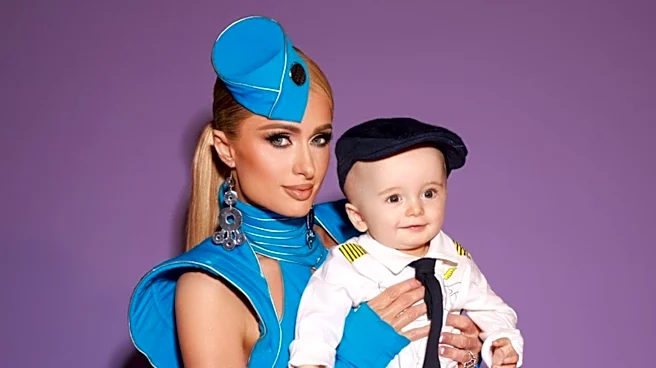
Paris Hilton has responded to criticism regarding her family's 'Beauty and the Beast' Halloween costumes. The DJ and businesswoman shared photos on Instagram featuring herself as Belle, her husband Carter Reum as the Beast, their three-year-old son Phoenix
as Lumière, and their two-year-old daughter London as Chip. Following the post, some social media users questioned why Hilton, rather than her daughter London, dressed as the Disney princess. Hilton clarified in the comments section that the costume choices were based on her daughter's preferences. She explained that 'Beauty and the Beast' is one of her children's favorite movies and that London specifically requested to dress as Chip, stating it was her favorite character.
Why It's Important?
This event highlights the increasing scrutiny public figures face on social media, even concerning personal choices like Halloween costumes. For celebrities like Paris Hilton, every aspect of their public and private life can become a subject of widespread discussion and judgment. The immediate and often critical feedback from online communities underscores the challenges of maintaining privacy and managing public perception in the digital age. It also reflects a broader cultural trend where parenting decisions of public figures are frequently debated, sometimes leading to misunderstandings or misinterpretations of their intentions. The incident demonstrates how quickly a seemingly innocuous family moment can escalate into a public discussion, impacting a celebrity's image and requiring direct engagement to clarify their actions.
What's Next?
While this specific incident is likely to fade as new news cycles emerge, it serves as a reminder for public figures like Paris Hilton to continue navigating the complexities of social media engagement. Celebrities will likely continue to share personal moments, but they may also become more strategic in how they present such content to anticipate and mitigate potential backlash. For the public, similar instances will likely continue to fuel discussions about celebrity culture, parenting, and the role of social media in shaping public opinion. This event may also contribute to ongoing conversations about online etiquette and the nature of criticism directed at public figures.
Beyond the Headlines
Beyond the immediate social media reaction, this situation touches upon the broader phenomenon of 'mom shaming' or 'parent shaming' that many public figures, particularly mothers, experience online. The expectation for celebrities to conform to certain ideals, even in their personal lives, often leads to intense scrutiny. This incident also subtly reflects the power dynamics within families, where children's preferences can genuinely dictate choices, yet public perception often assumes adult figures are always in control or seeking the spotlight. It underscores the performative aspect of social media, where even authentic family moments can be misconstrued, highlighting the constant pressure on public figures to justify their actions to a global audience.