









What's Happening?
CesiumAstro, a phased-array antenna specialist based in Texas, is currently undergoing a Series D funding round. This funding initiative is aimed at supporting the company's strategic transformation into a constellation operator. The Series D round is already
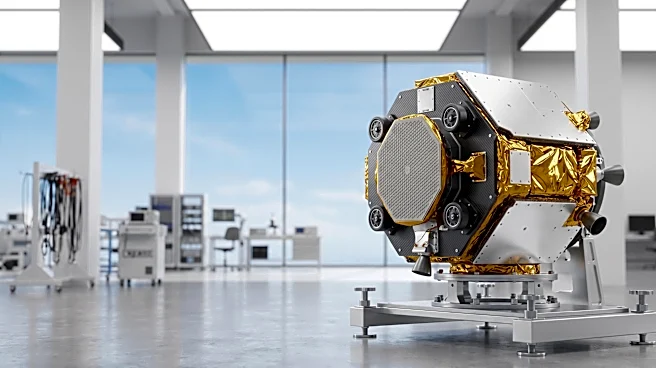
oversubscribed, indicating strong investor confidence. This development follows CesiumAstro's recent acquisition of mission software specialist 1Aardvark on August 25, marking its third acquisition in less than a year. These acquisitions are part of a broader strategy to bring more capabilities in-house. Earlier this month, CesiumAstro also acquired semiconductor specialist Jariet Technologies, its largest deal to date, which is expected to add tens of millions of dollars in revenue. The company previously secured a $270 million Series C round in February, led by Trousdale Ventures, alongside $200 million in debt financing from JP Morgan and the U.S. Export-Import Bank’s Make More in America initiative. CesiumAstro is preparing to deploy its first Element spacecraft in October, a precursor to its proposed Synchronicity constellation of 737 satellites.
Why It's Important?
This strategic shift by CesiumAstro is significant for the U.S. space industry, particularly in the commercial and national defense sectors. By transitioning from a component specialist to a constellation operator, CesiumAstro aims to provide autonomous and resilient connectivity solutions, which are crucial for both enterprise and government users. The acquisition of 1Aardvark, specializing in mission software for national defense programs, including missile defense and tracking, directly enhances the capabilities of CesiumAstro's Element spacecraft. This will allow the spacecraft to respond autonomously to changing conditions and maintain operations even with limited or disrupted connectivity, addressing critical needs for national security. Furthermore, the company's focus on developing a large-scale satellite constellation using Ku-, Ka-, and V-band spectrum will contribute to expanding broadband access and advanced communication services across various applications. The substantial funding rounds and strategic acquisitions underscore a growing trend of vertical integration within the space technology sector, aiming to control more aspects of the value chain and accelerate innovation.
What's Next?
CesiumAstro is set to deploy its first Element spacecraft in October, which will serve as a foundational step for its larger Synchronicity constellation. This constellation, planned to comprise 737 satellites, will utilize Ku-, Ka-, and V-band spectrum to deliver connectivity services to enterprise and government clients. The ongoing Series D funding round will further fuel these ambitious deployment plans and continued technological development. The company's strategy of acquiring specialized firms like 1Aardvark and Jariet Technologies suggests a continued focus on integrating advanced capabilities in-house, potentially leading to more acquisitions in the near future. These integrations are designed to enhance the autonomy and performance of their satellite systems. The success of the Element deployment and the subsequent build-out of the Synchronicity constellation will be critical in establishing CesiumAstro as a major player in the satellite connectivity market, potentially influencing the competitive landscape for other U.S. and international space companies.
Beyond the Headlines
The aggressive expansion and vertical integration strategy of CesiumAstro highlight a broader shift in the U.S. space industry towards more comprehensive, end-to-end solutions. This approach, driven by significant venture capital and debt financing, reflects a growing confidence in the commercial viability of large-scale satellite constellations for diverse applications, from internet connectivity to advanced defense capabilities. The emphasis on autonomous operations and resilient connectivity, particularly for national defense programs, points to the increasing convergence of commercial space technology with strategic national interests. This trend could lead to a more robust and self-reliant U.S. space infrastructure, reducing dependence on external suppliers for critical components and software. However, it also raises questions about market concentration and the potential for a few dominant players to control key aspects of space-based services. The rapid pace of acquisitions and technological development in this sector could also accelerate the timeline for next-generation space applications, impacting everything from global communication networks to military intelligence.