







What's Happening?
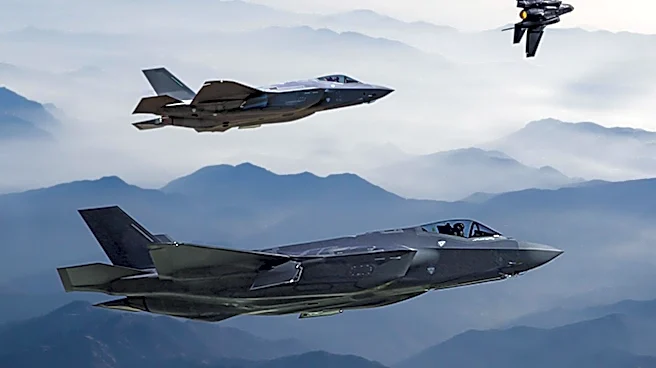
Collins Aerospace, an RTX business, announced the successful completion of altitude testing for its Enhanced Power and Cooling System (EPACS) designed for the F-35 fighter jet. This development marks a significant step in the competition to upgrade the F-35's
thermal management system, a critical need as the aircraft's advanced electronics generate substantial heat. The F-35's current Power and Thermal Management System (PTMS), supplied by Honeywell, struggles to meet the cooling demands of newer upgrades like Block 4 and the F135 Engine Core Upgrade. Over-tasking the existing system leads to accelerated engine wear and reduced engine life for the Pratt & Whitney F135 engine. Collins Aerospace's EPACS demonstrated approximately 80 kilowatts of cooling in 2024 lab testing, more than double the capacity of the current Honeywell PTMS. This new system aims to provide ample cooling headroom for future F-35 enhancements, ensuring the jet's long-term operational viability. The altitude testing validates EPACS's performance under real-world flight conditions, according to Ira Grimmett, Vice President, Environmental & Airframe Control Systems at Collins Aerospace.
Why It's Important?
The F-35's thermal management challenge is a significant issue impacting its performance and longevity. The current system's inability to adequately cool the jet's sophisticated electronics leads to increased strain on the F135 engine, resulting in higher maintenance costs and shorter operational lifespans. A successful upgrade to the Power and Thermal Management System is crucial for the F-35 program, which is a cornerstone of U.S. air superiority and a key export for allied nations. The competition between Collins Aerospace and Honeywell for this upgrade has substantial financial implications, potentially worth billions. The winning bid will determine the future capabilities and operational costs of the F-35 fleet for the U.S. military and its international partners. Collins Aerospace's successful altitude testing positions it strongly against Honeywell's proposal, which involves a phased software-based upgrade. The decision will influence not only the F-35's technical performance but also the strategic advantage of the U.S. and its allies in air combat.
What's Next?
The completion of altitude testing by Collins Aerospace for its EPACS system is a major milestone in the ongoing competition for the F-35's thermal management system upgrade. The Pentagon and the various nations operating the F-35 will now evaluate the proposals from both Collins Aerospace and Honeywell. The decision will likely involve a careful assessment of the long-term benefits of a clean-sheet replacement like EPACS, which offers significant cooling capacity for future upgrades, versus Honeywell's more incremental and potentially cheaper phased upgrade. The outcome will dictate the future development path for the F-35, influencing its ability to integrate new technologies and maintain its operational edge. Stakeholders will be closely watching for the final decision, which will have ripple effects across the aerospace and defense industry, particularly for RTX (Collins Aerospace's parent company) and Honeywell.
Beyond the Headlines
The F-35's cooling problem highlights a broader trend in modern military technology: the increasing demand for power and thermal management in highly integrated, electronics-intensive platforms. As advanced sensors, jammers, and processors become more powerful, the challenge of dissipating the heat they generate becomes a critical limiting factor. This issue extends beyond the F-35 to other next-generation military systems, underscoring the importance of innovation in thermal management solutions. The competition between Collins Aerospace and Honeywell also illustrates the strategic importance of subsystem development in the defense industry. Companies that can provide robust and scalable solutions for fundamental challenges like power and cooling gain a significant competitive advantage and can influence the trajectory of major defense programs. The long-term implications involve not just the F-35's performance but also the future design philosophies for military aircraft, emphasizing modularity and efficient thermal architectures.