








What's Happening?
Marathon Petroleum's refinery in Nikiski, Alaska, is facing significant challenges due to the scarcity of natural gas in the Cook Inlet region. Natural gas is a crucial input for the refinery, consuming 3 to 5 billion cubic feet to refine crude oil into
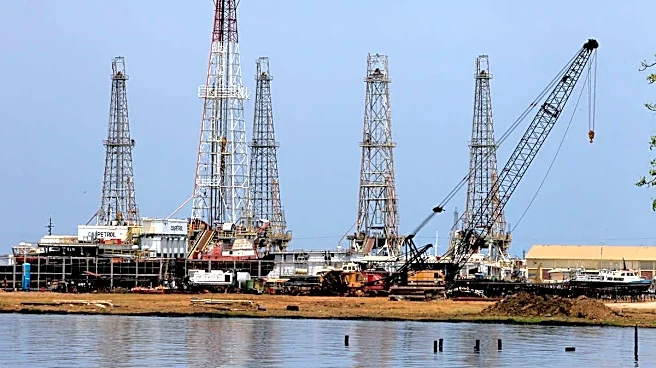
products like asphalt, gasoline, jet fuel, and propane. Casey Sullivan, government and public affairs manager for Marathon, stated that the company is no longer selling propane in the local market because it must utilize it to heat its products, calling it "not a recipe for success." Despite increasing drilling activity in Cook Inlet, production remains flat, with only two companies, HEX and Hilcorp, actively drilling. This situation is leading to higher operating costs and reduced product availability for the local market.
Why It's Important?
The natural gas supply issues directly impact Marathon Petroleum's operational efficiency and profitability at its Nikiski refinery, which is a vital source of refined petroleum products for Southcentral Alaska. The inability to sell propane locally due to internal consumption for heating highlights a critical supply chain vulnerability. This challenge could lead to increased prices for consumers in Alaska, as the refinery struggles to meet demand and maintain cost-effectiveness. The broader implication is a potential energy security concern for the region, as reliance on a dwindling local resource forces the refinery to make difficult operational choices. The situation also underscores the economic pressures on energy companies operating in regions with declining natural resource availability, affecting their ability to compete and serve local markets.
What's Next?
To address the natural gas shortage, HEX, an Alaskan-owned Inlet gas producer, plans to more than triple its commitment to Alaska's heating needs by next April, increasing its firm contract to Enstar to 26 million cubic feet of natural gas per day, with a further increase to 29 million in 2028. However, HEX President and CEO John Hendrix expressed uncertainty about commitments beyond five years, citing the unknown future of gas sales. HEX is also pursuing new drilling opportunities, including an agreement with Tyonek Native Corporation and Cook Inlet Region, Inc. to drill for gas in an onshore oil play within the next two years. Marathon Petroleum will likely continue to explore operational adjustments and potentially seek alternative energy sources or supply agreements to mitigate the impact of the natural gas scarcity on its refinery operations.
Beyond the Headlines
The natural gas supply challenges faced by Marathon Petroleum in Alaska reveal a deeper narrative about the sustainability of energy production in mature basins and the delicate balance between economic viability and resource depletion. The struggle to maintain flat production despite increased drilling activity in Cook Inlet suggests that the region's natural gas reserves are becoming harder and more expensive to extract. This situation could accelerate the transition towards alternative energy sources or necessitate significant infrastructure investments to import natural gas, potentially increasing costs for Alaskan consumers. The ethical dimension arises from the need to balance the immediate energy demands of the local population with the long-term environmental and economic sustainability of resource extraction. The uncertainty expressed by HEX's CEO about future gas sales highlights the inherent risks and long-term planning challenges in the energy sector, particularly in regions with finite resources.