







What's Happening?
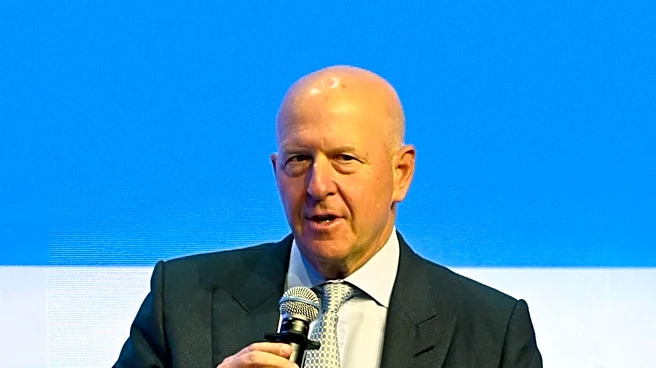
David Solomon, Chairman and CEO of Goldman Sachs, asserts that the discussion surrounding Artificial Intelligence (AI) is incorrectly framed as a binary choice between innovation and safety. Speaking in a 16-minute interview with Goldman Sachs Exchanges
host Allison Nathan, Solomon outlined a three-layer responsibility framework for AI deployment, involving governments, model builders, and deploying enterprises. He emphasized that financial services risk management, honed over decades and particularly after the 2008 financial crisis, offers a robust template for AI governance. Solomon believes that winning the AI era requires capturing its benefits while embedding accountability at every stage of deployment. He also highlighted Goldman Sachs' internal AI strategy, focusing on process automation and enhancing client experience, and announced a new $500 million small-business AI initiative aimed at helping small businesses adopt AI technologies. Solomon's perspective, detailed in a prior op-ed, rejects the notion that AI is fundamentally different from other technologies in terms of the need for thoughtful governance.
Why It's Important?
Solomon's framework is significant for the U.S. business landscape as it proposes a structured approach to managing the risks and opportunities presented by AI. By advocating for accountability across governments, AI developers, and deploying enterprises, he aims to foster trust and ensure responsible innovation. The emphasis on financial services risk management as a template suggests that established regulatory and control practices could be adapted for AI, potentially influencing future policy discussions and industry standards. This approach could help mitigate potential negative impacts of AI, such as job displacement, by promoting a more controlled and adaptable integration of the technology. The $500 million initiative for small businesses underscores the importance of ensuring that AI benefits are accessible beyond large corporations, potentially boosting productivity and competitiveness across a broader segment of the U.S. economy. This could lead to new job creation and economic growth, provided the transition is managed effectively.
What's Next?
The proposed three-layer accountability framework could influence future regulatory discussions and policy-making regarding AI in the U.S. Stakeholders, including government bodies, AI developers, and businesses, may consider adopting or adapting similar frameworks to ensure responsible AI deployment. The Goldman Sachs Small Business AI Institute, with its $500 million commitment, is expected to provide AI training and capital to small businesses, potentially leading to increased AI adoption and innovation in this sector. This initiative will likely serve as a case study for how large financial institutions can support broader economic integration of advanced technologies. Solomon anticipates that while job disruption is certain, new job creation will offset it, though policy actions might be needed to soften the transition if automation outpaces job creation. The market for AI infrastructure is also expected to undergo recalibration as investors assess real demand and the impact of faster, cheaper chips.
Beyond the Headlines
Solomon's argument challenges the prevailing binary narrative around AI, suggesting a more nuanced approach that prioritizes both innovation and safety. This perspective could shift public and policy discourse towards a more integrated understanding of AI's role in society. The comparison of AI governance to financial services risk management highlights a deeper implication: the need for a 'new muscle group' in risk and control practices for many enterprises deploying AI. This suggests a significant cultural and operational shift will be required across industries. Furthermore, the focus on small businesses in the AI adoption initiative points to a broader societal implication: ensuring equitable access to advanced technologies to prevent a widening digital divide and foster inclusive economic growth. The long-term impact of AI on the labor market, particularly the pace of job disruption versus creation, remains a critical ethical and economic consideration that will require ongoing monitoring and potential policy interventions.