

What's Happening?
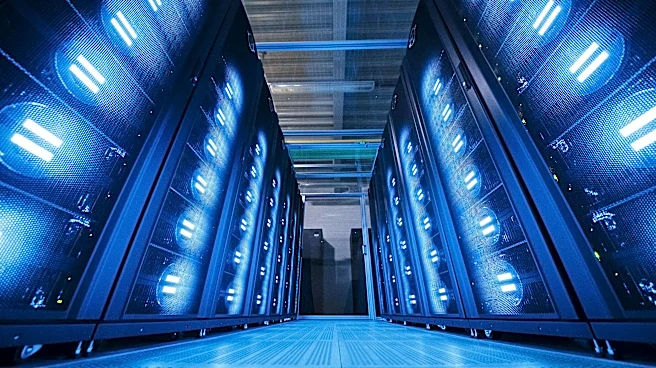
Hewlett Packard Enterprise (HPE) has announced the launch of its new hybrid supercomputing storage, which the company describes as the world's fastest for dense AI and scientific workloads. This development includes intelligent rack management and liquid
cooling technologies for high-performance systems. Additionally, HPE has outlined a product roadmap for its Cray E2000 configurations extending to 2027, which will feature future hybrid storage systems and advanced liquid cooling options. These high-performance systems are designed to support how large customers manage complex AI and scientific workloads across U.S. and international markets. HPE, with a market value of $66.6 billion, is positioning these innovations to align with the growing demand for AI infrastructure, focusing on dense data center hardware that can facilitate networking growth and recurring GreenLake and software revenue.
Why It's Important?
This announcement by HPE is significant for the U.S. technology sector and industries heavily reliant on advanced computing, such as scientific research, artificial intelligence development, and large-scale data analytics. The introduction of faster hybrid supercomputing storage and enhanced cooling solutions addresses critical challenges in managing the increasing computational demands of AI and scientific workloads. Improved storage economics and liquid cooling for high-density racks can lead to greater efficiency and reduced operational costs for businesses and research institutions. This move reinforces HPE's role as a key player in the AI infrastructure market, potentially driving further innovation and competition among technology providers. Companies that leverage these advanced systems stand to gain a competitive edge through faster data processing and more efficient AI model training, while those that do not adapt may fall behind.
What's Next?
The outlined 2027 product roadmap for Cray E2000 configurations suggests a sustained focus by HPE on evolving its supercomputing offerings. The critical next step for HPE will be to demonstrate meaningful deployments of these Cray E2000 hybrid storage and liquid-cooled rack systems in AI and High-Performance Computing (HPC) deals, with clear contributions to networking and GreenLake services. The success of these deployments will determine if these systems become a mainstream component of AI infrastructure or remain niche. Industry analysts and investors will be closely watching for concrete evidence of adoption and performance, which will influence HPE's market position and financial outlook. The broader market will also observe how competitors respond to HPE's advancements in supercomputing and AI infrastructure.
Beyond the Headlines
The continuous advancement in supercomputing and AI infrastructure, as exemplified by HPE's latest offerings, points to a broader trend of increasing computational power becoming a foundational element for economic and scientific progress. The emphasis on liquid cooling highlights the growing energy consumption concerns associated with high-density computing, pushing the industry towards more sustainable and efficient solutions. This technological arms race in AI infrastructure could also raise ethical considerations regarding data privacy and the responsible development of AI, as more powerful systems enable more sophisticated data processing capabilities. Furthermore, the integration of AI, cloud, and networking into a cohesive strategy by companies like HPE suggests a future where these technologies are inseparable, driving a holistic approach to enterprise IT solutions.