
What's Happening?
The packaging industry is undergoing a significant transformation as end-users increasingly demand greener materials, prompting Original Equipment Manufacturers (OEMs) to adapt their machinery and processes.
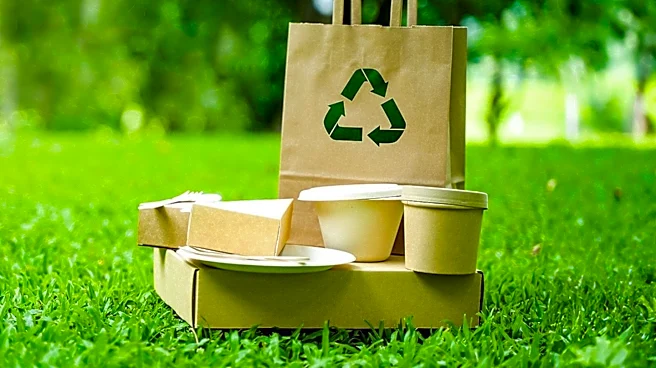
A research report from PMMI, The Association for Packaging and Processing Technologies, titled '2025 The New Material World: Packaging’s Path Toward Sustainability,' highlights that packaging decisions are largely driven by state mandates and retailer requirements due to a lack of strong federal guidance on sustainability. This pressure on consumer packaged goods (CPG) companies is, in turn, affecting OEMs, who are now expected to provide equipment compatible with sustainable materials. The report identifies higher production costs and concerns about diminished product protection and quality as primary barriers to adopting sustainable formats. Economic pressures, including direct material cost increases and downstream risks like product damage, are key deterrents for accelerating sustainability efforts. Companies are actively seeking to replace materials like polystyrene (PS), various foams, and polyvinyl chloride, while recycled paperboard with forestry certification, corrugate, and steel are expected to remain in use. Over 80% of respondents anticipate increasing their use of recyclable materials within the next five years, with recyclability being the top sustainability priority, especially where retailers mandate it.
Why It's Important?
This shift in the packaging industry has profound implications for U.S. businesses and consumers. The move towards sustainable materials, while environmentally beneficial, introduces significant economic and operational challenges. Higher production costs for sustainable packaging can lead to increased prices for consumer goods, potentially impacting household budgets. For CPG companies, balancing sustainability goals with maintaining product quality and shelf life is critical, as any compromise could affect brand reputation and consumer trust. OEMs face the substantial task of redesigning or modifying existing machinery, which requires significant investment in research, development, and manufacturing. This could create a competitive advantage for OEMs that innovate quickly, while those slower to adapt might lose market share. The fragmented regulatory landscape, with state laws and retailer mandates driving change more than federal guidelines, creates an inconsistent environment for businesses operating across different regions. This necessitates a more agile and regionally reactive approach to sustainable packaging strategies, adding complexity to supply chains and operational planning. Ultimately, the success of this transition hinges on effective collaboration between end-users and OEMs to overcome technical and economic hurdles, ensuring that sustainable practices do not compromise product integrity or affordability.
What's Next?
The packaging industry is poised for continued evolution, with a strong emphasis on collaboration between end-users and OEMs. Nearly two-thirds of OEMs are already manufacturing machinery redesigned or modified for sustainable materials, and close to half have up to 25% of their machinery adapted for this purpose. The top sustainability priorities for CPG companies include reducing packaging volume, adopting more recyclable materials, and minimizing operational waste. OEMs are aligning their strategies by designing machinery to support these goals. Consumer preference, cost, and legislation/regulation are identified as the top three influences on packaging over the next five years. The upcoming PACK EXPO International 2026 in Chicago will serve as a critical platform for industry stakeholders to explore material sustainability solutions, evaluate new equipment, and identify emerging trends. This event, held biennially, offers a significant opportunity for companies to stay competitive and enhance operational efficiency by researching materials and technologies. The ongoing challenge will be to navigate the rising costs of sustainable materials and concerns about product performance, while also addressing the complexities of a fragmented regulatory environment. Strategic partnerships between OEMs and end-users will be crucial to move beyond reactive adaptations and foster a more sustainable and resilient packaging future.
Beyond the Headlines
The transition to sustainable packaging materials extends beyond immediate economic and operational concerns, touching upon deeper ethical and cultural dimensions. The increasing consumer demand for environmentally friendly products reflects a growing societal awareness and expectation for corporate responsibility. Companies that fail to adapt risk not only regulatory penalties but also a decline in consumer loyalty and brand perception. This shift also highlights the ethical imperative for industries to minimize their environmental footprint, addressing issues like plastic pollution and resource depletion. The reliance on state-level mandates and retailer requirements, in the absence of comprehensive federal guidance, underscores a broader trend of decentralized governance in environmental policy. This can lead to innovation in some regions but also creates disparities and inefficiencies across the national market. Furthermore, the challenges of maintaining product quality and performance with new materials raise questions about the trade-offs between sustainability and functionality. The industry must invest in research and development to ensure that sustainable alternatives are not only eco-friendly but also meet the rigorous demands of product protection and consumer satisfaction. This ongoing evolution will likely foster a culture of continuous innovation, pushing the boundaries of material science and manufacturing processes to achieve a truly sustainable future.