



What's Happening?
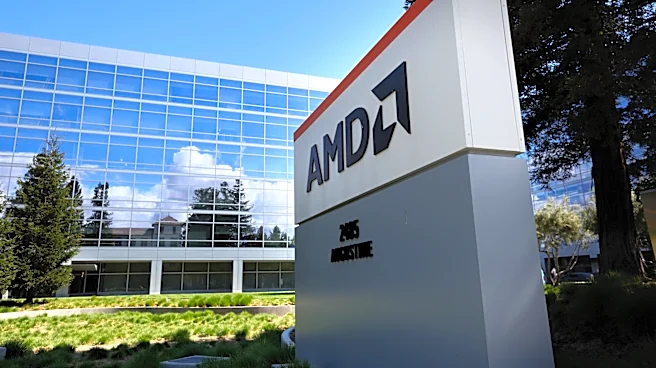
AMD has completed its acquisition of Taalas, a Toronto-based AI startup, in a deal valued at approximately $2.9 billion in cash and stock, with up to $1.4 billion contingent. The acquisition, announced in August and finalized on November 17, 2026, aims
to bolster AMD's research in AI models, enhance its inference capabilities, and advance hardware and system development for future superintelligence. Taalas's core innovation lies in its HC1 chip, which etches model weights directly into silicon, eliminating the need for fast memory like HBM and liquid cooling. This design allows for high performance, with Taalas claiming 17,000 tokens per second per user on its Llama 3.1 8B model, a significant improvement over existing solutions. The company's approach involves programming model weights into read-only memory during manufacturing, making the chip highly specialized for a single model. While this offers speed and efficiency, changing models requires manufacturing a new chip, a process Taalas states can take about two months.
Why It's Important?
This acquisition is a strategic move by AMD to gain a competitive edge in the rapidly evolving AI hardware market, particularly against rivals like Nvidia. By integrating Taalas's specialized chip technology, AMD aims to offer highly efficient and cost-effective solutions for AI inference, especially for model developers and infrastructure providers who require stable, long-term deployment of specific AI models. The ability to etch model weights directly into silicon could lead to hardware that is significantly cheaper to build and more energy-efficient, potentially disrupting the current reliance on general-purpose GPUs for AI inference. This could lower operational costs for AI service providers and accelerate the deployment of AI applications. However, the technology's limitation to single models means its adoption will likely be concentrated among users with well-defined and stable AI model requirements, creating a niche market for highly optimized inference hardware.
What's Next?
AMD plans to integrate Taalas's technology into its accelerator roadmap and develop system-level solutions alongside its Instinct GPUs. This integration is expected to create a division of labor where AMD's Instinct GPUs handle the more compute-intensive prompt processing, while Taalas-derived accelerators manage token generation. This strategy mirrors approaches seen in other companies, such as Cerebras, which pairs AMD Instinct GPUs with its CS-3 systems for disaggregated inference. The success of this integration will depend on AMD's ability to effectively market these specialized chips to customers who can amortize the cost of custom silicon over a sufficiently long service life of a particular AI model. Future developments will likely include the release of Taalas's second-generation chip, the HC2, which is expected to adopt a standard 4-bit floating-point format to address potential quality losses associated with the current 3- and 6-bit precision.
Beyond the Headlines
The acquisition highlights a growing trend in the AI industry towards hardware specialization to optimize performance and efficiency for specific AI workloads. While general-purpose GPUs have dominated AI training and inference, the emergence of dedicated AI accelerators like Taalas's HC1 suggests a future where hardware is increasingly tailored to the unique demands of AI models. This could lead to a more fragmented hardware ecosystem, with different solutions optimized for various stages of the AI lifecycle, from training to inference. The trade-off between flexibility (general-purpose GPUs) and efficiency (specialized chips) will be a key consideration for companies deploying AI. Furthermore, the rapid pace of AI model development, with new models emerging frequently, poses a challenge for hardware that requires a new chip for every model change. This dynamic will likely drive innovation in manufacturing processes to reduce the time and cost associated with producing custom silicon, making specialized hardware more adaptable to evolving AI landscapes.