



What's Happening?
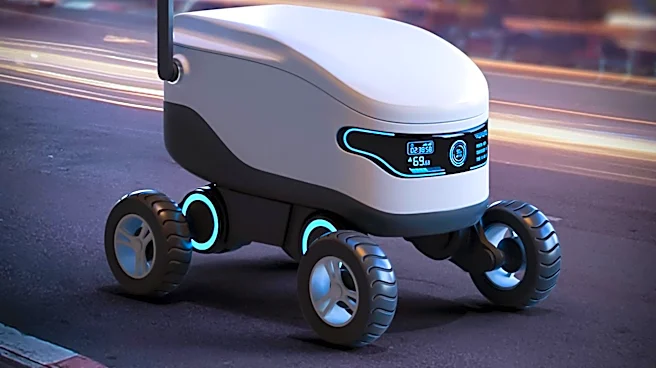
Starship Technologies, a company specializing in autonomous robot delivery, is facing scrutiny regarding the practical implementation and cost-effectiveness of its services for British businesses. While Starship's submission to UK Parliament reported
a significant increase in autonomous crossings from 3% in late 2017 to 85% at the time of submission, and claimed 99% autonomy with remote assistance needed for only 1 mile in every 1,000, these figures are being questioned for their relevance to actual labor savings. Critics argue that these metrics do not fully account for factors like recipient waiting times, loading durations, or the need for local employees to retrieve stranded robots. The company's model involves robots notifying remote operations when conditions change, with an operator confirming continuation or assisting with difficult terrain. This highlights the ongoing need for human intervention and support in the autonomous delivery process, which may impact the promised labor efficiencies for businesses.
Why It's Important?
The discussion surrounding Starship Technologies' autonomous delivery services is important because it sheds light on the complexities and hidden costs associated with integrating advanced robotics into business operations. For U.S. businesses considering similar autonomous solutions, this scrutiny serves as a crucial case study. The emphasis on defining clear responsibilities for robot recovery, assessing the full workflow improvement, and accurately calculating the total cost per successful delivery—including staff time for loading, waiting, and recovery—is vital. If the perceived labor savings from autonomous systems are not fully realized due to unaddressed operational challenges, businesses might face unexpected expenses and inefficiencies. This could impact investment decisions in robotics, potentially slowing the adoption of autonomous delivery solutions if the true return on investment is not transparently demonstrated. The experience in the UK underscores the need for comprehensive planning and contractual clarity when deploying such technologies.
What's Next?
Businesses considering autonomous delivery solutions, particularly in the UK, are advised to conduct thorough evaluations before committing to such services. This includes specifying repeatable routes, clearly assigning responsibility for failed deliveries, and scrutinizing autonomy figures to understand what they truly measure in terms of staff time and completed deliveries. Future contracts for autonomous delivery services will likely need to explicitly address scenarios like stranded robots, including who attends, within what agreed time, and at whose expense. The focus will shift towards evidence-based justification for expanding pilot programs, requiring proof that the complete workflow improves upon existing services under representative conditions. This will involve counting successful deliveries alongside loading, waiting, and recovery efforts, and retaining manual options if proposed savings do not materialize. The market may see a demand for more transparent pricing models that account for all operational aspects, including human support and potential manual fallback options.
Beyond the Headlines
The debate over Starship Technologies' operational metrics extends beyond mere business efficiency, touching upon broader implications for the future of work and the ethical considerations of automation. The distinction between 'autonomous crossings' or 'distance under remote control' and actual 'staff time per delivery' highlights a potential disconnect between technological capabilities and real-world operational demands. This raises questions about how companies market and define 'autonomy' in robotics, and the need for clearer, more comprehensive metrics that reflect the full human-robot interaction required for successful service delivery. Furthermore, the discussion about who retrieves a stranded robot and who bears the cost points to the evolving legal and ethical frameworks needed to govern autonomous systems. As automation becomes more prevalent, defining responsibility, ensuring safety, and understanding the true impact on human labor will be critical for societal acceptance and sustainable integration of these technologies.