
What's Happening?
In an exclusive excerpt from William Shatner's new memoir, 'William Shatner … and You,' Amazon founder Jeff Bezos reveals that his childhood love for 'Star Trek' was a primary inspiration behind the creation
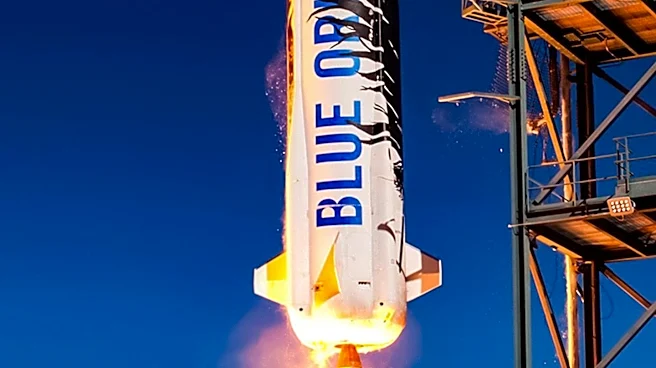
of his aerospace company, Blue Origin. Bezos, who launched Shatner into space in 2021 at the age of 90, shared how watching 'Star Trek' reruns as a ten-year-old in 1974, coupled with witnessing Neil Armstrong's moon landing, ignited his lifelong obsession with space travel. He recounted role-playing 'Star Trek' with friends, building paper tricorders and communicators, and even naming his management company, Zephram LLC, after the inventor of the warp drive, Zephram Cochrane. Bezos's dedication to the science fiction series is further evidenced by the studio model of the USS Enterprise in Blue Origin's headquarters and his dog named Kamala, after a 'Star Trek: The Next Generation' character. This deep-seated passion for a futuristic vision ultimately led him to devote a significant part of his life and resources to making space exploration a reality.
Why It's Important?
This revelation highlights the profound influence of popular culture and childhood aspirations on the trajectory of major U.S. industries and technological advancements. Jeff Bezos, one of the most influential figures in modern business, channeled his early fascination with 'Star Trek' into a multi-billion dollar venture, Blue Origin, which is now a key player in the burgeoning private space industry. This connection underscores how personal visions, often shaped by imaginative media, can translate into real-world innovation and economic impact. Blue Origin's efforts in space tourism and exploration contribute to the U.S.'s leadership in commercial spaceflight, fostering competition and driving technological progress. The story also illustrates a broader trend where individuals with significant financial resources are investing in ambitious, long-term projects, often driven by personal passions rather than immediate profit motives, thereby shaping the future of American technology and exploration. The narrative also subtly touches upon the environmental concerns Shatner experienced during his space flight, linking Bezos's long-term vision for moving polluting industries into space as a potential solution.
What's Next?
Bezos's continued leadership at Blue Origin, fueled by his enduring 'Star Trek' vision, suggests ongoing advancements in space technology and commercial spaceflight. The company is expected to continue its work on reusable rocket technology, lunar landers, and potentially orbital habitats, all aimed at making space more accessible and sustainable. This long-term commitment could further solidify the U.S.'s position in the global space race, attracting more investment and talent to the sector. The narrative also implies a future where the lines between science fiction and scientific reality continue to blur, inspiring new generations to pursue careers in STEM fields. As Blue Origin and other private space companies mature, they will likely face increasing scrutiny regarding the environmental impact of launches, the ethics of space tourism, and the equitable distribution of space resources. Bezos's vision of moving polluting industries into space, while ambitious, points to a future where environmental challenges on Earth might be addressed through extraterrestrial solutions, albeit with significant technological and logistical hurdles.
Beyond the Headlines
Beyond the immediate impact on space exploration, Bezos's story offers a compelling case study in the power of imagination and long-term vision in shaping technological frontiers. His childhood dream, nurtured by 'Star Trek,' evolved into a concrete business strategy, demonstrating how cultural narratives can serve as powerful catalysts for innovation. This phenomenon extends beyond space, influencing fields like artificial intelligence (as seen with Amazon's Alexa, also inspired by 'Star Trek's' computer) and other advanced technologies. The narrative also subtly highlights the role of wealth in enabling such ambitious, long-horizon projects, raising questions about the concentration of power and influence in shaping humanity's future. Furthermore, Shatner's emotional reaction to seeing Earth from space—a profound sense of grief for the planet—adds a poignant layer, suggesting that even as humanity reaches for the stars, the imperative to protect our home planet remains paramount. This juxtaposition of aspirational future and present-day environmental concerns underscores the complex ethical and philosophical dimensions of space exploration.