






What's Happening?
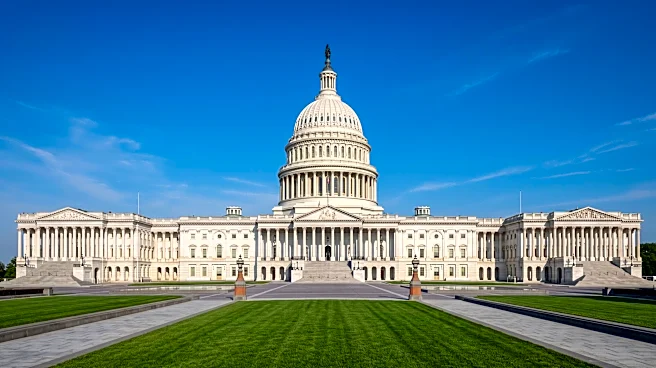
The U.S. House of Representatives Committee on Financial Services' Task Force on Monetary Policy, Treasury Market Resilience, and Economic Prosperity held a hearing titled 'Examining Derivatives' Role in the Treasury Market.' The hearing focused on the critical
function of derivatives, such as futures and swaps, in maintaining the liquidity, efficiency, and stability of the U.S. Treasury market. Witnesses, including Kevin McPartland from Crisil Coalition Greenwich, Terrance A. Duffy from CME Group, Jeff Cranston from Optiver, and Professor Yesha Yadav from Vanderbilt University Law School, provided expert testimony. Discussions highlighted how derivatives contribute to price discovery, risk management, and overall market functioning, enabling the U.S. government to finance its expenditures more efficiently. The committee also addressed the upcoming SEC central clearing requirements for cash Treasuries and repo transactions, and the implications of the Basel III Endgame reproposal on bank capital rules and market participation. Concerns were raised regarding the oversight structure of the consolidated Treasury and related markets, particularly the fragmentation of information and the potential risks associated with foreign regulators overseeing parts of the U.S. Treasury market.
Why It's Important?
The U.S. Treasury market, exceeding $30 trillion, is the bedrock of global capital markets and the benchmark for risk-free rates. Its resilience and liquidity are crucial for economic stability and the U.S. dollar's role as the world's reserve currency. Derivatives play a vital role by allowing market participants to hedge interest rate risks, infuse information into Treasury prices, and increase liquidity in both cash and repo markets. This efficiency ultimately lowers borrowing costs for the U.S. government, which can translate to lower mortgage rates and financing costs for American families and businesses. The discussion on central clearing is significant as it aims to reduce counterparty credit risk, improve transparency, and standardize risk management, thereby strengthening the market's infrastructure. The Basel III Endgame reproposal is important because it seeks to allocate capital more efficiently, encouraging banks to participate in these markets and maintain liquidity. However, concerns about fragmented oversight, potential risks from foreign regulatory bodies, and the need for robust data sharing between U.S. regulators highlight ongoing challenges that could impact the market's long-term stability and the U.S. financial system.
What's Next?
The SEC's central clearing rule for cash transactions is set to take effect in eight months, requiring market participants to prepare for this significant transition. The industry is currently focusing on developing clearing access models and ensuring margin efficiency, with recent approvals for customer-level cross-margining between CME Treasury futures and FICC-cleared Treasury positions being a meaningful step forward. The introduction of additional clearing agencies, such as CME and ICE, is expected to foster innovation and resilience, though potential market fragmentation will need to be monitored. Further improvements to the Basel III Endgame reproposal are anticipated, particularly in recognizing cross-product netting and cross-margining benefits to reduce pressure on bank balance sheets. Lawmakers and regulators will likely continue to address the concerns regarding the oversight structure of the Treasury market, including improving real-time information sharing and coordinating regulatory efforts to mitigate risks. The debate around tokenization of Treasury markets and the jurisdictional clarity for tokenized equities will also continue to evolve, with calls for cautious approaches to avoid further market fragmentation and ensure robust regulation.
Beyond the Headlines
The hearing delves into the intricate relationship between derivatives and the stability of the U.S. financial system, revealing deeper implications beyond immediate market transactions. The discussion on the potential for a non-U.S. regulator to oversee parts of the U.S. Treasury market, as highlighted by Terrance A. Duffy, raises critical questions about national financial sovereignty and systemic risk. The concern that a foreign central bank might prioritize its domestic financial system during a crisis, potentially at the expense of U.S. Treasury contracts, underscores the geopolitical dimensions of financial regulation. Furthermore, the ongoing challenges in achieving holistic oversight and data sharing across various U.S. regulatory bodies for the consolidated Treasury and related markets point to a fundamental structural weakness. This fragmentation could lead to undetected leverage and spillover effects, posing a 'real and present danger' to the market's stability. The debate also touches upon the ethical considerations of market speculation versus hedging, and the need for robust regulation to prevent market abuses, drawing parallels to past financial crises like AIG and Silicon Valley Bank. The future integration of new technologies like tokenization into these markets presents both opportunities for efficiency and risks of increased fragmentation and regulatory arbitrage, demanding careful consideration of their long-term impact on market integrity and investor protection.