



What's Happening?
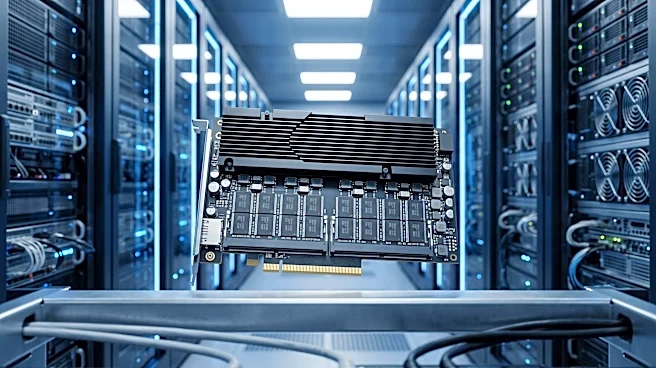
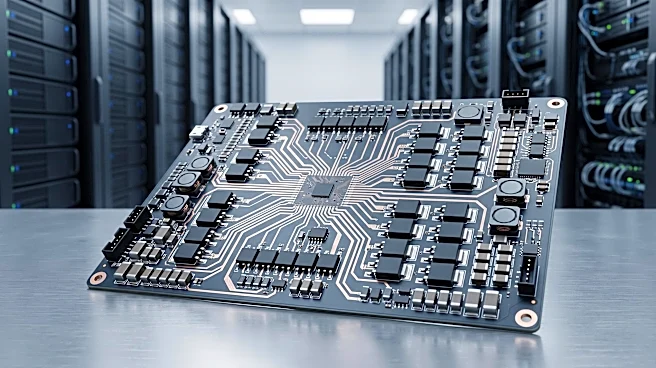
Navitas Semiconductor has announced a collaboration with NVIDIA to develop a new 24 kW, 800 V-to-12 V DC-DC power delivery board (PDB). This PDB, powered by GaNFast™ technology, is designed to support NVIDIA's MGX ecosystem and advance 800 VDC power architectures
for AI data centers. The solution aims to convert 800 VDC directly to 12 VDC in a single stage, eliminating the 50 V intermediate bus converter (IBC) power stage. This innovation is expected to boost system efficiency, reduce board space, and bring power closer to the Graphics Processing Unit (GPU). The PDB incorporates 16 GaNFast™ FETs on the primary side, configured in a stacked half-bridge topology, and is designed to deliver 24 kW with a target efficiency of 97% at full load and a power density exceeding 2,000 W/in³. The new PDB will be showcased at the NVIDIA AI Factory MGX Ecosystem partner display area at OCP Global Summit 2026.
Why It's Important?
This collaboration is significant for the advancement of AI infrastructure, particularly in data centers. The increasing power demands of AI compute are creating an 'AI infrastructure power wall,' and this new power delivery solution directly addresses that challenge. By eliminating power-conversion stages and increasing efficiency and power density, Navitas and NVIDIA are enabling more powerful and compact AI systems. This development can lead to substantial energy savings and reduced operational costs for data centers, which are major consumers of electricity. The ability to deliver power closer to the GPU minimizes power-delivery losses, which is crucial for maintaining high performance in AI applications. This also signifies a broader shift towards next-generation GaN and SiC high-power technologies, replacing legacy silicon in critical infrastructure.
What's Next?
The new 24 kW, 800 V-to-12 V PDB is slated for display at the NVIDIA AI Factory MGX Wall partner display area at OCP Global Summit 2026, where further details and demonstrations are expected. Navitas plans to continue expanding its portfolio of 800 VDC AI data-center platforms, offering customers greater flexibility in selecting optimal intermediate-bus voltage and VRM architectures for their power requirements. The adoption of this technology by NVIDIA, a key player in AI, suggests a potential industry-wide shift towards more efficient and high-density power delivery solutions for AI data centers. Future developments will likely focus on further optimizing power efficiency, increasing power density, and integrating these advanced power solutions into a wider range of AI computing platforms.
Beyond the Headlines
The development of this advanced power delivery board highlights a critical, often overlooked, aspect of the AI revolution: the immense energy requirements. As AI models grow in complexity and scale, the demand for efficient power management becomes paramount. This innovation not only addresses the immediate technical challenges of powering AI hardware but also has broader implications for sustainability in the tech industry. More efficient power conversion means less energy waste, contributing to a reduced carbon footprint for data centers. Furthermore, the shift to GaN and SiC technologies represents a long-term trend in semiconductor manufacturing, pushing the boundaries of what's possible in power electronics and potentially influencing other high-power applications beyond AI infrastructure. This technological leap could set new standards for energy efficiency and performance across various sectors.