




What's Happening?
Splice, known for its extensive library of human-made samples, has introduced its first digital audio workstation (DAW) named 'Create.' This new platform integrates agentic and assistive AI features designed to help novice producers learn the software
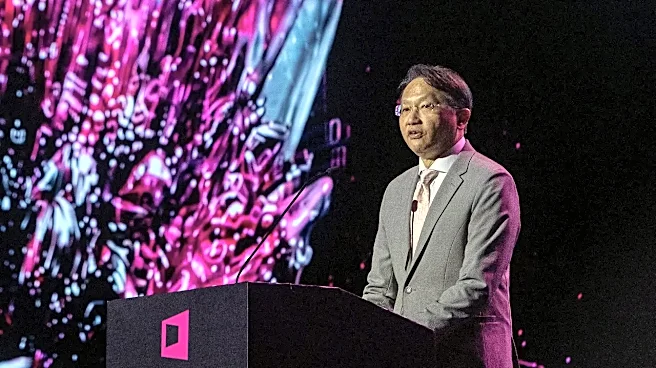
and complete songs. Key features include a chatbot that offers production tips and responds to voice or text prompts, as well as enhanced tools for mixing and matching samples from the Splice library. Splice's CEO, Kakul Srivastava, emphasized that the company's approach to AI is to empower creators rather than automate the creative process entirely, distinguishing it from 'push-button' generative AI solutions. The development of Create follows Splice's acquisition of Kits AI earlier in the year, leveraging their team's expertise to build a DAW that aims to collaborate with users in the music-making process.
Why It's Important?
Splice's entry into the DAW market with an AI-powered platform is significant as it aims to disrupt a space traditionally dominated by established players like Ableton and Logic. By focusing on assistive AI, Splice is positioning itself to attract new producers who may find traditional DAWs too complex. This approach could democratize music production further, making it more accessible to a wider audience. The platform's emphasis on human-created samples combined with AI assistance also highlights a growing trend in the music technology industry: using AI to enhance creative workflows rather than replace human input. This could influence how other DAW developers integrate AI, potentially shifting the market towards more collaborative and user-friendly AI tools that support, rather than dictate, the creative process.
What's Next?
The launch of Splice's 'Create' DAW is expected to intensify competition in the digital audio workstation market, particularly among platforms targeting new and aspiring producers. Other DAW developers may respond by accelerating their own AI integration efforts, focusing on assistive features that enhance user experience and workflow. Splice will likely continue to refine 'Create' based on user feedback, potentially adding more AI-driven tools that maintain its philosophy of empowering creators. The success of 'Create' could also influence the broader music technology landscape, encouraging more companies to explore agentic AI for creative applications. Furthermore, it may lead to increased partnerships between sample libraries and DAW developers to offer more integrated and AI-enhanced production environments.
Beyond the Headlines
Splice's 'Create' represents a nuanced approach to AI in creative fields, moving beyond simple generative models to focus on assistive intelligence. This distinction is crucial as it addresses concerns about AI diminishing human creativity. By providing tools that guide and collaborate with users, Splice is advocating for a future where AI acts as a powerful co-pilot rather than an autonomous creator. This could foster a new generation of musicians who are adept at leveraging AI to realize their artistic visions, potentially leading to innovative musical styles and production techniques. The platform also implicitly raises questions about the evolving skill sets required for music production, where understanding how to effectively interact with AI tools might become as important as traditional music theory or engineering knowledge.