


What's Happening?
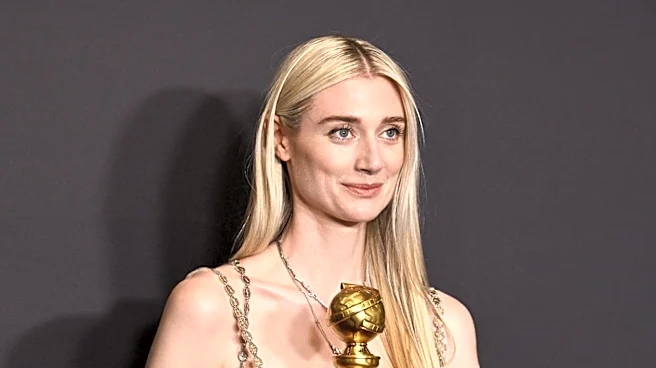
Actress Elizabeth Debicki is navigating her career following her acclaimed role as Princess Diana in 'The Crown.' She recently discussed her upcoming projects, including 'The Further Mis-Adventures of Cliff Booth,' a continuation of the 'Once Upon a Time
in...Hollywood' narrative, and 'Wicker,' a film where she plays the Tailor's Wife. Debicki initially believed the offer to audition for 'Cliff Booth' from director David Fincher was a hoax, highlighting the unexpected turns in her career. She also reflected on the challenges of being typecast after a prominent role and the process of finding new, compelling characters. Her experience includes working with notable directors such as Christopher Nolan, Baz Luhrmann, and Steve McQueen, often before the age of 30. Debicki's early career began with her role as Jordan Baker in Baz Luhrmann's 'The Great Gatsby,' which she secured after an audition with Tobey Maguire and a memorable encounter with Leonardo DiCaprio.
Why It's Important?
Elizabeth Debicki's career trajectory post-'The Crown' offers insight into the dynamics of Hollywood for actors who achieve significant recognition for a specific role. Her experience underscores the pressure to diversify and avoid typecasting, a common challenge for performers in the entertainment industry. Her involvement in high-profile projects like 'The Further Mis-Adventures of Cliff Booth' demonstrates her continued demand and ability to transition between diverse roles, from historical figures to complex fictional characters. The discussion of her audition process for 'The Great Gatsby' also illustrates the often serendipitous and high-stakes nature of securing major roles in Hollywood, impacting an actor's career path and public perception. Her candid reflections on learning from failures and the importance of a balanced personal life resonate with broader discussions about mental well-being and career sustainability in demanding industries.
Beyond the Headlines
Debicki's comments on avoiding social media due to its negative impact on her self-perception highlight a growing concern among public figures and the general populace regarding digital well-being. Her decision to disengage from platforms like Instagram to manage her 'own reception' points to the psychological toll of constant public scrutiny and comparative thinking fostered by social media. This perspective offers a deeper look into the personal strategies individuals employ to maintain mental health in an increasingly connected world, especially within an industry where public image is paramount. Furthermore, her desire to explore comedy, a genre she feels she is 'pigeonholed' out of, speaks to the creative limitations actors often face despite their versatility, revealing the industry's tendency to categorize talent rather than embrace its full spectrum.