






What's Happening?
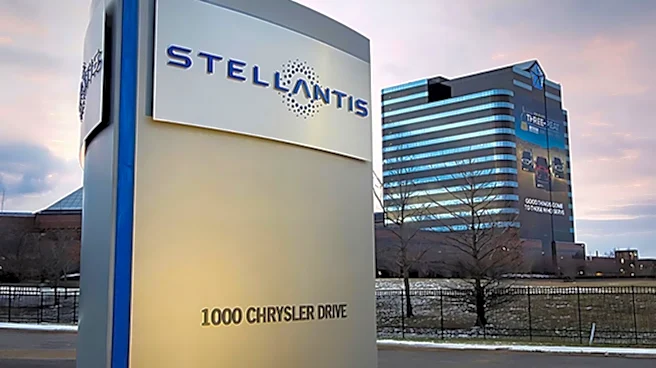
Stellantis, the multinational automotive manufacturer, is aggressively integrating Artificial Intelligence (AI) into its vehicle development processes to significantly reduce project timelines and improve efficiency. Engineers at Stellantis report that
AI tools have transformed year-long projects into weeks and overnight simulations into minutes. This push is part of a broader strategy to cut vehicle development time from four years to 24 months, starting with two models in 2027, and to achieve a 7% operating margin by 2030, as targeted by CEO Antonio Filosa. While AI is speeding up tasks like engineering design checks and software development, engineers emphasize the continued need for human oversight and validation, particularly in safety-critical applications. The company is also working to simplify its complex vehicle architecture, consolidating hundreds of electronic control units into a central 'brain' called STLA Brain.
Why It's Important?
This strategic shift by Stellantis is highly significant for the U.S. automotive industry. By leveraging AI to accelerate development cycles, Stellantis aims to bring new models to market faster, enhancing its competitiveness against rivals. The focus on improving operating margins through efficiency gains is crucial for the company's financial health, especially given its exposure to the European market and past challenges with electric vehicle (EV) ambitions. The integration of AI also signals a broader transformation in automotive engineering, potentially setting new industry standards for design, testing, and manufacturing. This could lead to more advanced and reliable vehicles for consumers, while also impacting the workforce by shifting job roles towards more architectural and oversight functions rather than process-oriented tasks.
What's Next?
Stellantis plans to continue expanding its use of AI, with Chief Engineering & Technology Officer Ned Curic indicating a hiring push for 'multiple hundreds' of engineers in Europe and the U.S. this year. The company is also betting on partnerships with startups for advanced technologies like solid-state batteries, with prototypes already in testing. The goal is to move towards a culture where innovation doesn't solely rely on in-house development. However, the transition will involve overcoming resistance from some engineers who fear losing core skills and adapting to new ways of working. The company anticipates it will take approximately four years to fully trust AI in safety-critical applications, aligning with its 2030 margin target. This period will be crucial for validating AI's reliability and integrating it seamlessly into all aspects of vehicle production.
Beyond the Headlines
The deeper implications of Stellantis' AI push extend to the future of work, the nature of innovation, and consumer expectations in the automotive sector. The concept of engineers making themselves 'redundant' by automating tasks, as promoted by Ned Curic, suggests a fundamental shift in professional roles, emphasizing creativity, problem-solving, and architectural thinking over repetitive processes. This could lead to a demand for new skill sets and continuous learning within the engineering workforce. For consumers, the increased use of AI could lead to more personalized, safer, and feature-rich vehicles, but also raises questions about data privacy, the complexity of in-car technology, and the balance between digital interfaces and traditional mechanical controls. The industry's reliance on AI also highlights the ethical considerations of autonomous systems and the need for robust regulatory frameworks to ensure safety and accountability.