







What's Happening?
Archer Aviation, a developer of electric vertical takeoff and landing (eVTOL) aircraft, has announced a multiyear partnership with AEG, a sports and live entertainment company, to establish downtown Los Angeles's first vertiport at L.A. Live. This collaboration
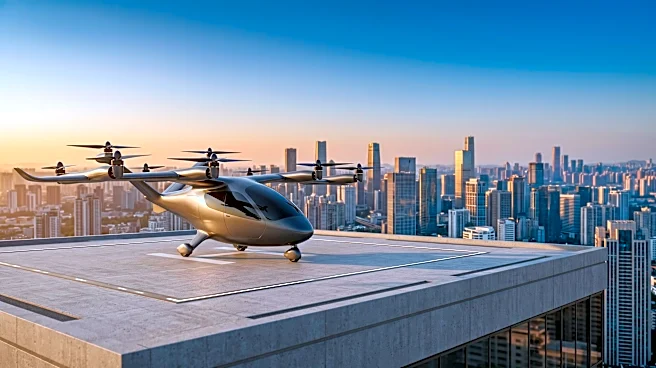
aims to integrate Archer's Midnight air taxis into the urban transportation network, offering a new mode of travel for attendees of events at Crypto.com Arena, Peacock Theater, and other L.A. Live venues. The Midnight air taxis are designed to carry four passengers, reach speeds of up to 150 mph, and significantly reduce commute times, potentially turning two-hour drives into 10- to 20-minute flights. The companies have completed an initial feasibility study, including land-use, airspace, power availability, and community impact assessments, and are now proceeding with reviewing operational approaches and guest experiences. This initiative is part of Archer's broader plan to develop an extensive air taxi network across Southern California, with L.A. Live serving as a central hub, especially in anticipation of the 2028 Los Angeles Olympics.
Why It's Important?
This partnership marks a significant step in the advancement of urban air mobility in the United States, particularly in a major metropolitan area like Los Angeles. The introduction of eVTOL vertiports at key entertainment and sports districts could revolutionize how people commute to large-scale events, alleviating traffic congestion and reducing travel times. For the sports and entertainment industry, this offers a premium transportation option that could enhance the fan experience and attract a new demographic of attendees. Economically, it represents a substantial investment in infrastructure and technology, potentially creating new jobs and fostering innovation in the aerospace and transportation sectors. Archer Aviation, as the official air taxi provider for the 2028 Los Angeles Olympics, stands to gain significant visibility and market penetration. The success of this project could serve as a blueprint for similar urban air mobility initiatives in other U.S. cities, impacting urban planning, environmental policies due to zero operating emissions, and the broader transportation landscape.
What's Next?
The next phase of the project involves a detailed review of the operational approach and guest experience for the L.A. Live vertiport. While the exact landing and takeoff locations are yet to be determined, the ongoing studies will finalize these critical details. Archer Aviation will continue to expand its planned air taxi network across Southern California, which includes locations such as SoFi Stadium, USC, LAX, Hollywood Burbank Airport, Santa Monica, Orange County, and the recently acquired Hawthorne Airport as its central operational hub. The company will also need to secure necessary approvals from the Federal Aviation Administration (FAA) for commercial service operations of its eVTOL aircraft. With the 2028 Los Angeles Olympics approaching, there will be a concentrated effort to ensure the vertiport and air taxi services are operational and integrated into the city's infrastructure to support the influx of visitors and athletes. Public engagement and community impact assessments will also be crucial as the project moves forward.
Beyond the Headlines
The development of a vertiport at L.A. Live extends beyond mere transportation convenience; it signifies a paradigm shift in urban infrastructure and mobility. This initiative could set a precedent for how cities integrate advanced air mobility solutions, influencing future urban planning and zoning regulations. The ethical implications of noise pollution, airspace management, and equitable access to such premium services will become increasingly relevant as these networks expand. Culturally, the sight of air taxis ferrying passengers above cityscapes could reshape public perception of travel and technology, potentially normalizing what was once considered futuristic. Furthermore, the project highlights the growing convergence of technology, entertainment, and urban development, creating new business models and partnerships. The long-term success of this venture could accelerate the adoption of electric aviation, contributing to broader environmental goals by reducing carbon emissions from traditional ground transportation and potentially inspiring further innovation in sustainable urban living.