






What's Happening?
SL Green Realty Corp. (NYSE:SLG), a prominent Manhattan office landlord, is under scrutiny following its latest company update. The company reported a notable rise in same-store cash net operating income, excluding lease termination income, during the
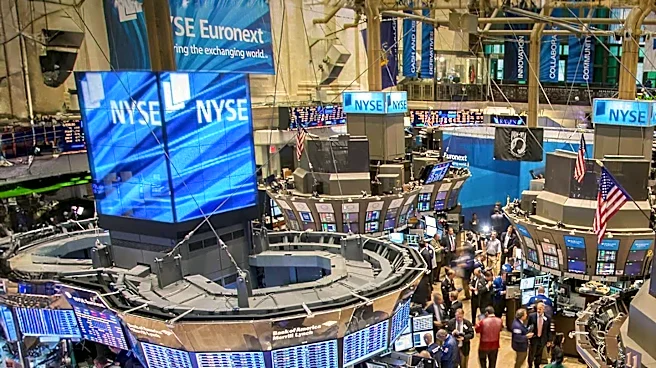
recent quarter. However, asset sales played a central role in this quarter's performance. SL Green Realty's contribution to index returns is primarily influenced by factors specific to Manhattan office demand and real estate credit markets, rather than the broader U.S. economy. Key risks identified include refinancing costs, a dependence on asset sales to fund its balance sheet, fluctuations in tenant demand in Manhattan, and the inherent volatility that one-off transaction income introduces into Funds from Operations (FFO). The company's shares trade on the New York Stock Exchange as part of the Russell 1000 index, with the last updated price at $47.77 on November 18, 2026.
Why It's Important?
The performance of SL Green Realty is a bellwether for the Manhattan commercial real estate market, and its challenges highlight broader trends affecting urban office spaces across the U.S. The reliance on asset sales rather than recurring rental income for financial stability indicates a potentially unsustainable model in the long term, especially if market conditions for property transactions become less favorable. Refinancing costs are a critical concern, as rising interest rates could significantly impact the company's profitability and financial flexibility. The specific focus on Manhattan office demand means that SL Green Realty's fortunes are closely tied to the city's economic health and evolving work patterns, such as hybrid or remote work models. This situation could influence investment decisions in other major U.S. urban centers, as investors assess the risks associated with single-city or single-sector real estate portfolios.
What's Next?
Moving forward, the most crucial indicators for SL Green Realty will be its leasing activity and continued asset recycling efforts. Consistent progress in these areas would suggest that recent improvements are sustainable, while any slowdown would prompt a more intense focus on cost control and strategic priorities. The company will also need to provide further clarity on its refinancing plans and distribution coverage to reassure investors. The operating environment, characterized by occupancy trends, tenant demand, and rental growth, will continue to shape the company's results. Observers will be looking for sustained improvement across key metrics like occupancy, Funds from Operations, same-store income, and leverage to determine the long-term trajectory of SL Green Realty amidst the evolving commercial real estate landscape.
Beyond the Headlines
The situation at SL Green Realty reflects a significant paradigm shift in the commercial real estate sector, particularly for office properties. The emphasis on asset sales to manage the balance sheet, rather than organic growth from rental income, points to a market grappling with fundamental changes in how office space is utilized. This could lead to a re-evaluation of traditional valuation models for commercial properties and a greater emphasis on flexibility and adaptability in real estate portfolios. The risks associated with new supply in key markets and tenant concentration further complicate the outlook, suggesting that even strong demand might not guarantee stable margins. This scenario could accelerate the adoption of innovative leasing models, flexible workspace solutions, and a greater focus on tenant experience to attract and retain occupants in a competitive and evolving market.