





What's Happening?
Wonder, a food tech and delivery company, is developing a fully autonomous system for food production and delivery, integrating AI, robots, and drones. The company aims to offer a comprehensive food service, from generating customer meal plans based on dietary
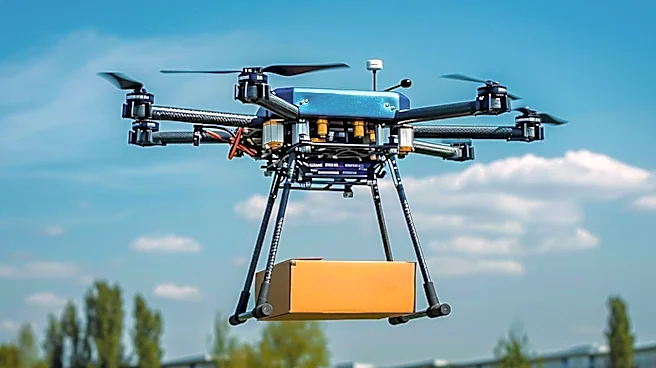
needs to preparing and delivering meals with minimal human intervention. Wonder currently operates approximately 160 brick-and-mortar locations along the East Coast, each offering up to 30 different restaurant brands. Customers can order through the Wonder app or third-party delivery services like DoorDash, Uber Eats, and Grubhub. Wonder also owns Blue Apron meal kits, categorizing its offerings as 'food for later' and 'food for now.' The company plans to introduce a location outside Dallas next year, equipped with its bowl-making robot, the Infinite Makeline, and integrated with a drone delivery network operated by Zipline. Human employees will perform final touches and labeling, a process expected to take as little as 30 seconds. Wonder was founded in 2018 by Marc Lore and has raised over $3 billion to fund its ambitious goals.
Why It's Important?
This initiative by Wonder signifies a significant shift in the food service industry, potentially revolutionizing how food is prepared and delivered. The integration of AI, robotics, and drone technology could lead to substantial reductions in operating costs, particularly labor costs, which could translate into lower prices for consumers. This model could also expand the reach of food delivery services, as drones can travel faster and cover larger areas than traditional human couriers. For the U.S. economy, this could create new job categories in technology development, maintenance, and oversight, while potentially displacing some roles in traditional food preparation and delivery. The move towards automation could also enhance efficiency and consistency in food quality. Furthermore, Wonder's ownership of Blue Apron meal kits suggests a broader strategy to capture various segments of the food market, from immediate consumption to meal preparation at home, indicating a comprehensive approach to food tech innovation.
What's Next?
Wonder plans to launch its advanced autonomous food platform in Texas as early as next year, starting with a location outside Dallas that will feature the Infinite Makeline robot and drone delivery via Zipline. The company anticipates that within five years, significant portions of its business will be operating on this autonomous model, including AI-generated meal plans for customers. While some tasks, such as cooking and assembling burgers, will initially remain human-centric, Wonder is actively developing more robotic solutions, including the Infinite Mise for ingredient picking and Infinite Sauce for sauce preparation. The company also aims to use an AI-powered kitchen display system to optimize order orchestration. Wonder's CEO, Tony Hoggett, indicated that while the initial investment in automation is higher, the ability to house 30 restaurants under one roof with shared automated systems will lead to favorable unit economics and rapid growth.
Beyond the Headlines
The development of Wonder's autonomous food platform raises several deeper implications beyond immediate cost savings and delivery efficiency. Ethically, the increasing reliance on AI and robotics in food preparation and delivery prompts questions about the future of human employment in the service sector and the potential for job displacement. There are also considerations regarding data privacy, as AI systems will be generating personalized meal plans based on customer tastes and dietary needs. Culturally, this shift could alter consumer expectations for speed, convenience, and customization in food service. The long-term impact on local food economies and small businesses, which may struggle to compete with highly automated and cost-efficient models, also warrants attention. Furthermore, the environmental footprint of drone delivery networks and the energy consumption of advanced robotic kitchens will be important factors to monitor as these technologies scale.