




What's Happening?
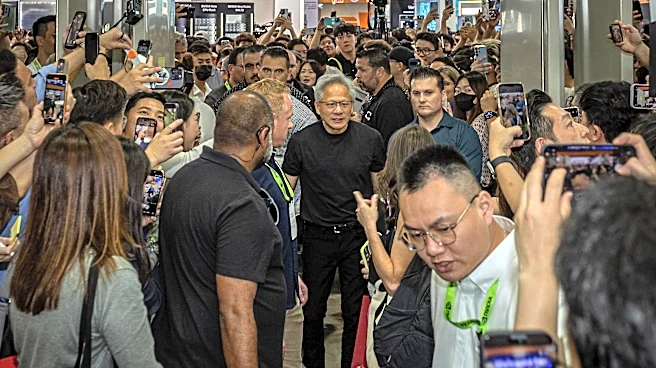
Nvidia experienced a significant market value drop of $1.1 trillion following reports concerning its CEO, Jensen Huang's, personal life, including an alleged affair. This event has brought to light the financial risks associated with companies where the founder's
identity and reputation are deeply intertwined with the corporate entity, a phenomenon termed 'personality cult capitalism' by The Observer. Huang, who co-founded Nvidia 33 years ago, has led the company to become a dominant force in AI chip supply, controlling over 85% of the global market. The company's response to the initial reports was noted for its unusual wording, and further scrutiny revealed Nvidia's governance structure lacks an independent chair, has 60 direct reports to Huang, and no clear succession plan. This concentration of authority in one individual has raised concerns about the company's ability to manage crises independently and its overall institutional dependence on Huang.
Why It's Important?
The situation at Nvidia underscores a growing trend in the AI industry where founders maintain significant control, potentially weakening shareholder democracy. Companies like Anthropic, SpaceX, and OpenAI are structured in ways that grant founders disproportionate voting rights compared to their economic ownership. For instance, Anthropic's proposed public offering includes a single Founder share giving co-founders 50.1% of voting rights, while Elon Musk's dual-class voting structure at SpaceX would leave him with approximately 85% of voting rights. This concentration of power allows founders to retain decisive control even as they seek public investment, limiting the influence of ordinary shareholders. The financial implications extend beyond individual companies, as Nvidia's central role in AI infrastructure means its stability affects a wider financing network, potentially creating broader market exposure if confidence in such a central company falters.
What's Next?
The increased scrutiny on governance structures in AI companies may lead to greater pressure from investors and regulators for more balanced corporate control. As more AI companies consider public offerings, the models adopted by Anthropic and SpaceX could either become precedents or face significant pushback from market participants concerned about shareholder rights. The financial markets will likely continue to react to developments concerning key figures in these founder-led companies, potentially influencing investment strategies and valuations. Companies may need to re-evaluate their succession planning and board independence to mitigate risks associated with over-reliance on a single individual, especially as they grow in market influence and public ownership.
Beyond the Headlines
The rise of 'personality cult capitalism' carries profound implications beyond corporate finance, touching upon political influence and societal development. The Observer highlights how unelected technology billionaires can impact international security, information flows, and national policies, citing Elon Musk's control over Starshield in Ukraine and Jensen Huang's advocacy for AI chip sales to China. This concentration of power means that decisions made by a few individuals can shape critical global issues. Furthermore, the long-term stability of these organizations is questioned, drawing parallels to the instability seen in other entities after the departure of dominant leaders. The ethical dimension of such concentrated power in shaping AI's development and its impact on how societies organize work and interact with technology also comes into focus, raising questions about accountability and democratic oversight in the rapidly evolving tech landscape.