




What's Happening?
AMD and Nvidia have announced a combined investment of $4 billion in Meta's equity offering, with Nvidia contributing $3 billion and AMD $1 billion. This investment is part of a broader strategy to expand Meta's artificial intelligence (AI) infrastructure
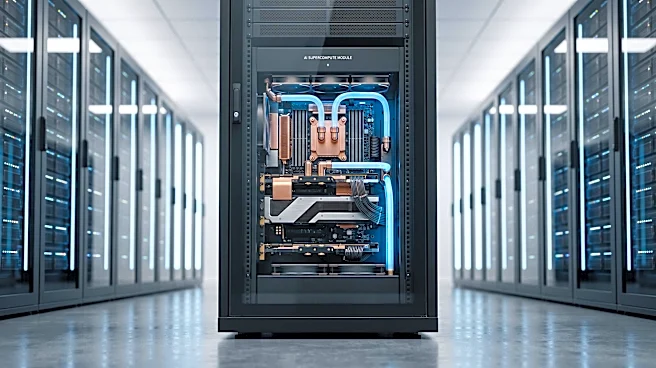
and deepen technological cooperation between the semiconductor giants and the social media company. Meta plans to raise a total of $97.5 billion for AI infrastructure expansion, including $37.5 billion through stock offerings and an additional $60 billion via an 'ATM' method of selling stocks at market prices. AMD's Helios rackscale solutions are currently being tested in Meta's data centers, with plans for broader deployment and the future adoption of a custom AI accelerator based on AMD's Instinct graphics card architecture. AMD EPYC processors are already powering Meta's Muse personal AI agent, with millions of EPYC chips deployed. Nvidia's investment is linked to Meta's expanded use of Nvidia's AI computing platform 'Vera Rubin' and CPU 'Vera,' and both companies will collaborate on improving Meta's AI agent 'Muse' to enhance AI model performance and reduce operating costs. AMD Chair and CEO Lisa Su emphasized that Meta is a strategic partner, built through years of deep technical collaboration, and that the companies are working together to build gigawatt-scale infrastructure and shape future generations of silicon, software, and systems for Meta's superintelligence models.
Why It's Important?
This significant investment by AMD and Nvidia in Meta underscores the escalating importance of AI infrastructure and the strategic alliances forming within the technology sector. For AMD, this partnership solidifies its position in the burgeoning AI market, demonstrating its capability to compete with industry leaders like Nvidia in providing advanced AI solutions. The deployment and testing of AMD's Helios rackscale solutions and EPYC processors within Meta's vast infrastructure validate AMD's technology and could lead to substantial future revenue streams as these products move beyond the trial stage. For Nvidia, the continued expansion of its AI technology cooperation with Meta, including the adoption of its Vera Rubin platform and Vera CPU, reinforces its dominance in AI computing. The investments also highlight a growing trend where semiconductor companies are not just suppliers but also equity investors in their key AI customers, creating a symbiotic relationship that ensures funding for AI development while securing market share for chipmakers. This dynamic fosters intense competition and innovation, ultimately accelerating the development and deployment of advanced AI capabilities across various industries, impacting everything from data processing to consumer-facing AI agents.
What's Next?
Following these investments, Meta is expected to continue its aggressive expansion of AI infrastructure, with facility investments projected to be between $135 billion and $145 billion this year. The ongoing testing of AMD's Helios rackscale solutions will likely lead to broader deployment, and the development of a custom Instinct GPU for Meta is anticipated. Investors will be closely watching AMD's third-quarter results, due on November 3, 2026, for confirmation of Helios shipments and updated guidance on data center GPU performance. The collaboration between AMD, Nvidia, and Meta will focus on optimizing AI models and reducing operational costs, which could lead to more efficient and powerful AI agents and services. This strategic alignment is also expected to drive further innovation in semiconductor design and software development, as both chipmakers will leverage technical data from their partnerships to improve future products. The trend of semiconductor companies investing in AI firms is likely to continue, fostering a more integrated ecosystem where hardware and software development are closely intertwined, potentially leading to new industry standards and accelerated AI advancements.
Beyond the Headlines
The investments by AMD and Nvidia in Meta signal a deeper strategic shift in the technology landscape, moving beyond traditional supplier-customer relationships to integrated partnerships. This model, where chipmakers become equity stakeholders in their major clients, creates a powerful incentive for mutual success and shared risk. It also raises questions about market concentration and potential anti-competitive implications as key players consolidate their influence across the AI value chain. The emphasis on 'gigawatt-scale' infrastructure highlights the immense energy demands of advanced AI, prompting discussions about sustainable computing and the environmental impact of rapidly expanding data centers. Furthermore, the development of 'superintelligence models' and personal AI agents like Muse, powered by these advanced semiconductors, has profound societal implications. These AI systems could revolutionize how individuals interact with technology, access information, and perform daily tasks, but also bring forth ethical considerations regarding data privacy, algorithmic bias, and the future of human-AI collaboration. The long-term success of these partnerships will depend not only on technological advancements but also on navigating these complex ethical and regulatory challenges.