








What's Happening?
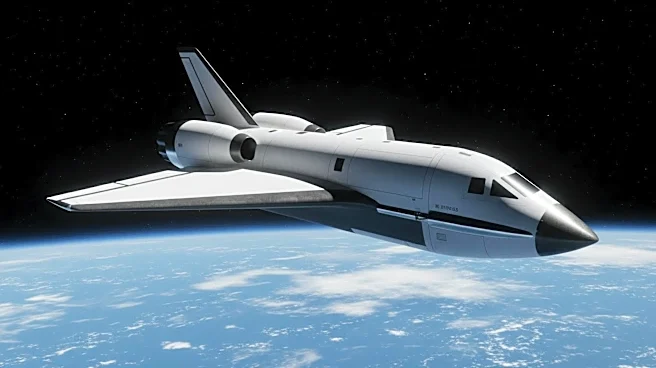
A 25-year-old entrepreneur, Sree Supranayi, is spearheading a significant development in India's space sector with the creation of a reusable spaceplane through her startup, AnduraX. The company aims to make space-based manufacturing commercially viable
by leveraging microgravity to produce purer materials and larger protein crystals. AnduraX successfully conducted a high-altitude balloon drop test in May 2026, validating key technologies for their spaceplane. The startup plans to support manufacturing, research, and cargo missions in orbit, with demonstration missions targeted by 2028 and cargo operations for the Bharatiya Antariksh Station by 2030.
Why It's Important?
The development of a reusable spaceplane by AnduraX represents a significant advancement in space technology, potentially positioning India as a key player in the space manufacturing industry. This innovation could lead to breakthroughs in pharmaceuticals and semiconductors, as manufacturing in microgravity allows for the production of purer materials. The success of this project could attract further investment in India's space sector, fostering technological advancements and economic growth. Additionally, it aligns with global trends where countries like the USA, Russia, and China are utilizing spaceplane technology for various applications, including defense.
What's Next?
AnduraX plans to continue its development with a small variant of the spaceplane, ARES, set for a demonstration mission in 2028. By 2030, the company aims to have a fully operational spaceplane capable of carrying cargo to the Bharatiya Antariksh Station. The startup also envisions expanding its capabilities to include human spaceflight by 2032. These developments could lead to increased collaboration with international space agencies and private companies, further integrating India into the global space industry.
Beyond the Headlines
The initiative by AnduraX highlights the growing trend of privatization in space exploration, where private companies are increasingly taking on roles traditionally held by government agencies. This shift could lead to more rapid technological advancements and cost reductions in space travel and manufacturing. Furthermore, the focus on space-based manufacturing could drive new industries and job creation, potentially transforming the economic landscape by establishing space as a new frontier for industrial activity.